
Vital Signs for Children: Normal Ranges and How to Check Them
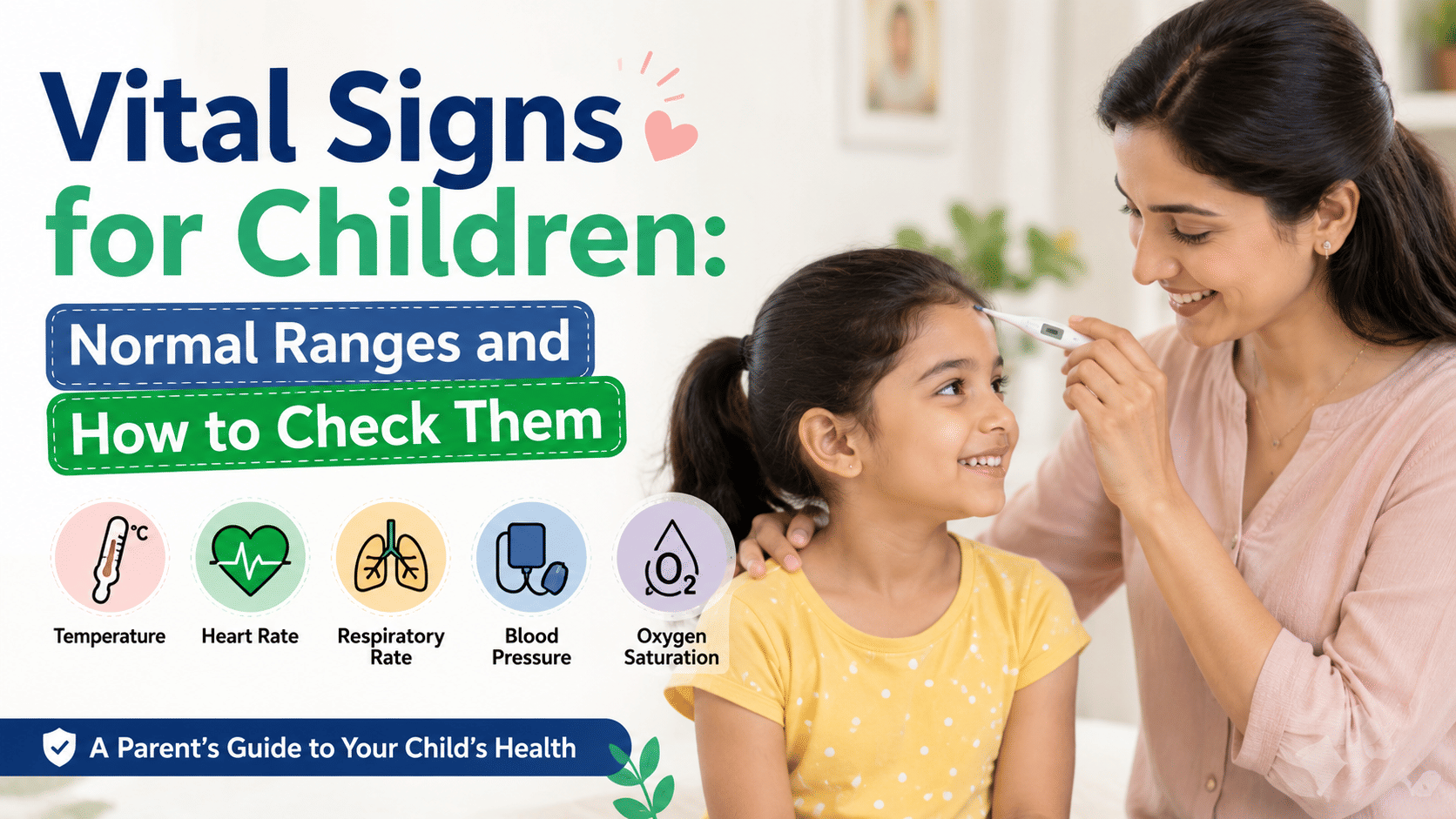
Vital signs are measurements that provide information about a child’s basic body functions. The four traditional vital signs are:
- Body temperature
- Heart or pulse rate
- Respiratory rate
- Blood pressure
Healthcare professionals may also measure oxygen saturation, level of alertness, pain and capillary refill when assessing an unwell child.
Understanding vital signs for children can help parents describe symptoms accurately and follow a clinician’s home-monitoring instructions. However, most healthy children do not need routine vital-sign checks at home. A child’s behaviour, breathing effort, colour, feeding and responsiveness remain equally important.
Call emergency services if a child is struggling to breathe, has blue or grey lips, is difficult to wake, becomes unresponsive, faints or has a seizure. Do not wait for every vital sign to become abnormal.
Normal Vital Signs for Children Chart
The following table provides general resting reference ranges for healthy, awake children. It is based primarily on the parent-facing Cleveland Clinic chart.
Different clinical charts use somewhat different limits, especially for newborns and infants. The child should be calm and rested, and the figures should not be used to diagnose an illness without clinical context.
Temperature and oxygen saturation
- A typical temperature is commonly around 36.5–37.5°C, although it varies with the measurement site, time of day and activity.
- A temperature of 38°C or higher is generally considered a fever.
- Oxygen saturation is usually 95%–100% in healthy people at sea level, although altitude and medical conditions can produce different expected values.
 Dr. Prateek Phaldesai
Why Do Normal Ranges Differ Between Charts?
There is no single table that fits every situation.
A chart may describe:
- A healthy child resting at home
- An awake child
- A sleeping child
- A child crying during an examination
- An unwell child in hospital
- An emergency threshold rather than an average value
- A child living at high altitude
- A particular measurement method
Royal Children’s Hospital notes that published paediatric ranges are diverse because researchers have studied different populations using different assessment methods. It recommends considering repeated trends and the child’s condition rather than relying only on one number.
That is why two reputable sources may display different but overlapping ranges.
1. Body Temperature
Body temperature reflects the balance between heat produced and heat lost by the body. A child’s temperature may vary with:
- Time of day
- Physical activity
- Warm clothing or blankets
- Environmental heat
- The measurement site
- Illness
- Recent bathing
- The thermometer and technique
A fever is generally a temperature of 38°C or higher, but the child’s age and condition determine how urgently it should be evaluated.
How to check a child’s temperature
Use a digital thermometer and follow its instructions. Common sites include:
- Rectum
- Forehead
- Mouth
- Ear
- Armpit
Rectal measurements are considered the most accurate, particularly in infants younger than three months. Forehead readings are generally the next most accurate. Oral measurements are not usually recommended until a child is approximately four years old, and ear thermometers are not reliable in babies younger than six months.
Do not use a mercury thermometer.
When fever needs prompt medical advice
A baby younger than three months with a rectal temperature of 38°C or higher needs prompt medical evaluation, even when no other symptoms are present.
Seek medical help for a child of any age when fever accompanies:
- Difficulty breathing
- Extreme sleepiness
- A seizure
- Stiff neck
- Severe headache
- Persistent vomiting
- Dehydration
- An unexplained rash
- A child who appears seriously unwell
2. Heart Rate or Pulse
Heart rate is the number of times the heart beats in one minute.
Children normally have faster heart rates than adults. The rate gradually decreases as the child grows. It also rises temporarily with activity, crying, anxiety, pain, fever and dehydration and becomes slower during sleep.
Normal pulse rate for children
General resting ranges are approximately:
- Newborn: 110–160 bpm
- Infant: 100–160 bpm
- Toddler: 90–150 bpm
- Preschool child: 80–140 bpm
- School-aged child: 70–120 bpm
- Adolescent: 60–100 bpm
These broader age-group figures are used in the current Geeky Medics clinician guide and largely overlap with WebMD’s parent reference.
What is a normal pulse for a newborn?
Newborn references vary according to whether the baby is awake or asleep.
PedsCases lists approximately:
- Awake: 100–205 bpm
- Asleep: 90–160 bpm
A sleeping newborn can therefore have a considerably lower pulse than an awake, crying baby.
How to check a child’s pulse
- Let the child sit or rest calmly for at least five minutes.
- Place the first two fingertips-not the thumb-over the pulse on the inside of the wrist.
- Count the beats for 30 seconds and multiply by two.
- Count for a complete minute if the rhythm seems irregular.
- Record whether the child was awake, sleeping, crying, feverish or recently active.
A clinician may use an apical pulse heard with a stethoscope in infants or when the wrist pulse is difficult to feel.
When a pulse reading is concerning
Contact a healthcare professional when an unusually fast or slow pulse:
- Persists after the child has rested
- Is accompanied by chest pain
- Feels irregular
- Occurs with fainting
- Accompanies breathing difficulty
- Occurs with pale, blue or grey skin
- Appears alongside severe weakness or poor responsiveness
One elevated reading after running or crying is different from a persistent abnormal resting rate.
3. Respiratory Rate
Respiratory rate is the number of complete breaths taken in one minute. One rise and fall of the chest or abdomen counts as one breath.
Children breathe more quickly than adults, particularly during infancy. Respiratory rate may rise with fever, crying, pain, anxiety and activity.
How to check a child’s breathing rate
- Wait until the child is calm or asleep.
- Watch the chest or abdomen.
- Count every rise for a full minute.
- Avoid telling an older child to “breathe normally,” because conscious attention can change the pattern.
- Note whether the breathing appears easy or effortful.
A full minute is especially important in babies because their breathing can be irregular.
Look beyond the number
A respiratory rate inside an expected range does not guarantee that breathing is normal.
Seek urgent medical assessment for:
- Skin pulling in between or below the ribs
- Nasal flaring
- Grunting
- Head bobbing in a baby
- Wheezing or a harsh breathing sound
- Pauses in breathing
- Difficulty feeding because of breathlessness
- Blue, grey or unusually pale lips
- A child who is tiring or becoming less responsive
Increased breathing effort is an urgent sign even when a home oxygen reading appears acceptable.
-> Consult a Pediatrician Online
4. Blood Pressure
Blood pressure measures the force of circulating blood against the artery walls.
The two numbers are:
- Systolic pressure: pressure while the heart contracts
- Diastolic pressure: pressure while the heart relaxes
What is normal blood pressure for children?
For children younger than 13, normal blood pressure cannot be defined by age alone. Clinicians interpret it according to:
- Age
- Sex
- Height
A healthy reading is generally below the 90th percentile for those characteristics. For adolescents aged 13 and older, a reading below 120/80 mm Hg is considered normal under widely used paediatric guidelines.
The numerical ranges in a general chart are therefore only rough orientation. They should not be used to diagnose hypertension.
How blood pressure is checked
Accurate measurement requires:
- A cuff sized for the child’s upper arm
- The child sitting or lying calmly
- The arm supported
- Minimal talking or movement
- Repeat measurements when the first value is unusual
A cuff that is too small may produce a falsely high reading, while one that is too large may distort the result.
Most children begin routine annual blood-pressure checks from age three. Younger children may be checked when they have particular medical risk factors.
Parents generally should not monitor a healthy child’s blood pressure at home unless a clinician has recommended it.
5. Oxygen Saturation
Oxygen saturation, or SpO₂, estimates the percentage of haemoglobin carrying oxygen.
A pulse oximeter usually clips onto a finger or toe and displays:
- Oxygen saturation
- Pulse rate
- Sometimes signal strength
Most healthy individuals have readings between 95% and 100%, but expected levels may be lower at high altitude or with certain heart and lung conditions.
How to improve the reading
- Use a device and probe suitable for the child’s size.
- Make sure the hand or foot is warm.
- Keep the child still.
- Remove nail polish from the measured finger.
- Wait until the displayed number stops changing.
- Follow the manufacturer’s instructions.
Important pulse-oximeter limitations
Accuracy can be affected by:
- Movement
- Poor circulation
- Cold skin
- Device fit
- Nail polish
- Skin thickness
- Skin pigmentation
- A consumer device not evaluated for clinical decisions
The FDA advises users not to rely only on a pulse-oximeter number and to consider symptoms and how the person looks and feels.
Seek medical advice for a persistently concerning reading, especially when the child has coughing, difficulty breathing, unusual sleepiness or colour changes. A child who is clearly struggling to breathe needs urgent help regardless of the displayed number.
What Can Temporarily Change a Child’s Vital Signs?
This is why a resting repeat measurement often provides more useful information than one value taken immediately after activity or distress.
Checking Vital Signs for Children at Home
Check only when there is a reason
Appropriate reasons may include:
- The child appears unwell
- A clinician has asked for monitoring
- The child has a chronic heart or lung condition
- You are tracking fever
- You are observing recovery after treatment
- A prescribed medication can affect pulse or blood pressure
Routine daily measurement is unnecessary for most healthy children.
Let the child settle first
Where possible, wait at least five minutes after:
- Running
- Crying
- Bathing
- Eating a large meal
- Drinking a hot or cold beverage
- Becoming upset
Record the context
Write down:
- Date and time
- Exact reading
- How it was measured
- Whether the child was awake or asleep
- Recent activity
- Fever or medication
- Symptoms
- Whether the reading changed when repeated
Focus on trends
A steadily rising respiratory rate or pulse can be important even when each measurement still falls near a published range.
Similarly, a single borderline value in an active, crying child may return to normal after rest. Clinical teams therefore interpret repeated readings alongside the child’s appearance and behaviour.
When to Get Medical Help
Seek emergency care when a child:
- Is struggling or working hard to breathe
- Has blue, grey or very pale lips or skin
- Is unresponsive or difficult to wake
- Faints
- Has a seizure
- Has severe chest pain
- Has pauses in breathing
- Becomes floppy or confused
- Has a rapidly worsening condition
Contact a healthcare professional promptly when:
- An infant younger than three months has a temperature of 38°C or higher.
- A resting pulse remains far outside the expected age range.
- Breathing remains unusually fast or slow.
- The pulse feels irregular.
- A home blood-pressure reading is repeatedly abnormal.
- Oxygen saturation remains below the level advised by the child’s clinician.
- Readings are worsening over time.
- The numbers concern you even though the child appears reasonably well.
A numerical chart cannot override a parent’s concern that a child looks seriously ill.
-> Consult a Pediatrician Online
Frequently Asked Questions
What are the four main vital signs for children?
The traditional four are body temperature, pulse, respiratory rate and blood pressure. Oxygen saturation is also commonly measured in clinics and hospitals.
What is a normal pulse rate for children?
It depends on age. Approximate resting rates range from around 100–160 beats per minute in infants to 60–100 in adolescents. Rates are usually higher while awake or active and lower during sleep.
What is a normal pulse for a newborn?
Different references use different limits. PedsCases lists an awake range of approximately 100–205 beats per minute and a sleeping range of 90–160. The baby’s activity, temperature, breathing and overall condition must also be considered.
What is normal blood pressure for children?
For children under 13, normal blood pressure depends on age, sex and height and is generally below the 90th percentile. For adolescents 13 and older, normal is below 120/80 mm Hg.
What is the normal human pulse-rate range?
The familiar adult resting range is usually 60–100 beats per minute. Children, especially babies, normally have faster heart rates, so adult limits should not be applied to them.
How often should parents check vital signs?
Most healthy children do not need regular home checks. Measure them when the child is ill, when instructed by a clinician or when monitoring a known condition.
Should respiratory rate be counted for 30 or 60 seconds?
A complete minute is preferable, particularly in babies and whenever breathing is irregular. A calm older child with regular breathing may be counted for 30 seconds and the result doubled.
Is one abnormal reading an emergency?
Not always. Activity, crying, fever, pain or incorrect equipment can alter a reading. Let the child rest and repeat it when appropriate.
Do not delay care when the child has breathing difficulty, abnormal colour, fainting, confusion, a seizure or poor responsiveness.
Can a home pulse oximeter diagnose low oxygen?
No. It provides an estimate and can be inaccurate. The reading must be considered together with symptoms, breathing effort, colour and clinical advice.
Final Takeaway
Normal vital signs for children change substantially with age. Babies have faster heart and breathing rates than older children, while blood pressure gradually rises with growth.
Use age-appropriate equipment, measure when the child is calm and compare repeated readings rather than relying on one number. Most importantly, look at the whole child. Breathing effort, skin colour, alertness, feeding and responsiveness may reveal serious illness before every value crosses a chart threshold.