
12 Signs of an Intelligent Child-and What They Really Mean
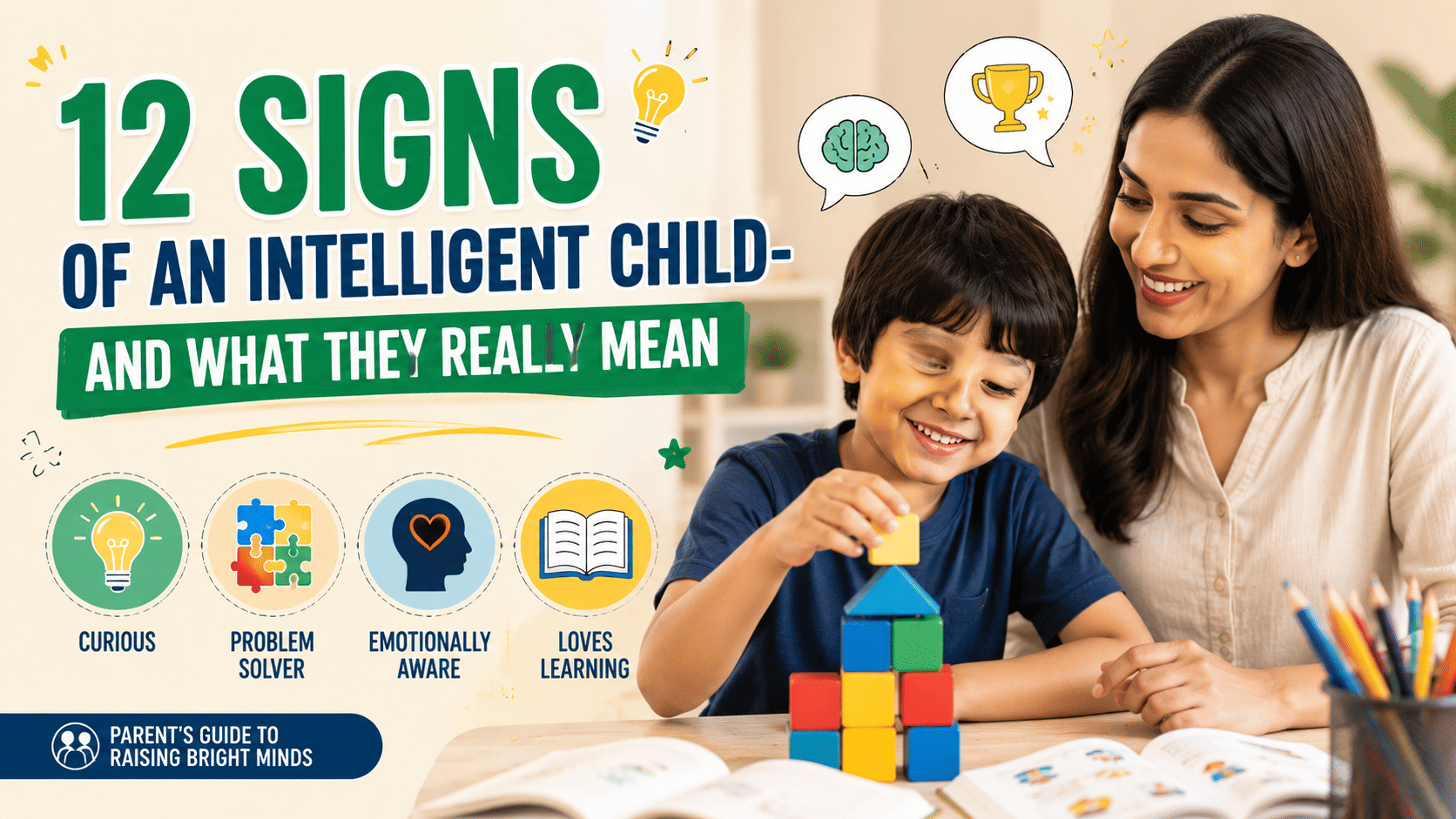
Parents naturally notice when a child remembers surprising details, asks unusually difficult questions or learns something after seeing it only once. These behaviours may suggest particular intellectual strengths, but they do not provide a home test for intelligence or giftedness.
There is no single official checklist that proves a child is highly intelligent. Giftedness itself has several definitions, and children can display advanced ability in language, reasoning, mathematics, music, art, leadership or another specific domain. Formal identification should consider the child relative to others with similar ages, experiences and opportunities.
The following signs of an intelligent child are therefore best treated as patterns worth observing-not labels or guarantees.
Possible Signs at a Glance
A child does not need to show all these behaviours. Some gifted children show one or two very intensely, while others present a less obvious or uneven profile.
1. They Learn New Ideas Quickly
Some children understand new material after fewer demonstrations or repetitions than their age peers. They may grasp the underlying rule rather than simply memorising the example.
For instance, a child who learns one type of number pattern may independently apply the same reasoning to a more difficult sequence. Another may understand a grammar rule and begin using it in unfamiliar sentences.
 Little Joys
The meaningful observation is not merely speed. Look for whether the child:
- Understands the concept accurately
- Transfers it to a new situation
- Can explain the idea
- Retains it over time
- Requires less review once it is mastered
Rapid comprehension and needing relatively little repetition are commonly described in giftedness resources, but they vary by subject. A child can learn very quickly in science while needing typical or additional support in writing.
2. They Ask Questions That Build on One Another
Most children ask many questions. A potentially significant pattern is when the questions form an investigation.
Instead of stopping after “Why does it rain?”, the child might continue:
- Where was the water before it entered the cloud?
- Why do some clouds produce rain and others do not?
- Would rain fall differently on another planet?
- How can scientists measure water inside a cloud?
The child is not simply requesting facts. They are testing explanations, noticing missing information and building a larger mental model.
Persistent curiosity and questions about complex ideas appear across the strongest giftedness sources. However, a quiet child may demonstrate the same curiosity through reading, drawing, building or private experimentation rather than frequent conversation.

3. They Notice Patterns and Connections
An intelligent child may see relationships that other children have not yet noticed.
Examples include:
- Recognising a repeating numerical pattern
- Connecting a story’s problem with an event in real life
- Noticing that two scientific processes follow similar rules
- Identifying inconsistencies in an explanation
- Grouping objects using an unexpected but logical category
- Applying a strategy from one game to another
Pattern recognition is often more informative than memorising isolated facts because it shows that the child is organising and applying information.
4. They Approach Problems in More Than One Way
Some children accept the first workable solution. Others continue asking whether there is a quicker, fairer or more elegant approach.
A child may:
- Invent a new rule for a game
- Find several ways to solve a calculation
- Rebuild a structure after identifying its weak point
- Use an ordinary object for an unexpected purpose
- Explain why more than one answer could be reasonable
- Spot a loophole in instructions
Creativity, flexibility and unconventional problem-solving form part of several recognised approaches to giftedness. The Canadian Psychological Association describes creativity and task commitment alongside exceptional ability in one major model of gifted learning.
5. They Develop Deep, Specific Interests
Many children become enthusiastic about dinosaurs, vehicles, space or animals. The possible sign is the depth, persistence and organisation of the interest.
The child might:
- Learn specialist vocabulary
- Classify information into categories
- Remember fine distinctions
- Seek increasingly advanced sources
- Create models, stories or experiments
- Return to the subject for months or years
- Correct adults when a detail is imprecise
A deep interest is not proof of general intelligence. It may indicate a particular talent, a strong personal passion or a neurodevelopmental difference. The useful response is to support exploration while keeping daily life balanced.
6. They Remember and Apply Meaningful Details
Strong memory appears in most ranking pages, but memory should be understood carefully.
A child may remember:
- A route taken once
- Dialogue from a story
- A scientific fact and where they learned it
- A promise made several weeks earlier
- Detailed instructions
- The structure of a song
- A previous strategy that solves a new problem
The strongest indicator is not the ability to recite random facts. It is using remembered information to understand, predict, compare or solve something new.
Memory also varies by interest. A child may remember every species of shark but regularly forget where they left their shoes.
7. Their Communication Shows Unusual Complexity
Some intelligent children speak early, read early or use a large vocabulary. Others do not.
Possible signs include:
- Explaining complex ideas clearly
- Using precise words
- Understanding figurative language
- Changing explanations for different listeners
- Constructing detailed stories
- Discussing abstract concepts
- Noticing ambiguity in a question
Early speech is neither necessary nor sufficient for giftedness. The Canadian Psychological Association includes advanced vocabulary and early reading among possible characteristics, while also emphasising that not all gifted learners display the same profile.
A child with advanced nonverbal reasoning may have ordinary language development, a speech-language difficulty or be learning in more than one language.
8. They Produce Original Ideas
Creativity may appear through art, music, storytelling, construction, humour, imaginary play or scientific thinking.
Look for a child who:
- Combines ideas from unrelated areas
- Invents detailed imaginary systems
- Creates unusual endings to stories
- Experiments rather than copying a model
- Develops multiple uses for one object
- Challenges an assumption constructively
- Enjoys open-ended questions
A beautifully finished craft copied from an example does not necessarily show more creativity than a rough but completely original design.
9. They Understand Complex Humour or Wordplay
Several specialist, lifestyle and parent-generated pages mention unusually mature humour.
A child might:
- Create puns
- Understand double meanings
- Recognise irony
- Build a joke around an earlier conversation
- Deliberately violate an expected pattern for comic effect
- Adjust a joke for a particular audience
Humour can combine language, memory, timing, social awareness and flexible thinking. It is still only one possible clue, not an intelligence test.
10. They Teach Themselves
Self-directed learners do not always wait for formal instruction.
They may independently:
- Work out how a toy or machine functions
- Learn to read parts of familiar books
- Research a question
- Practise a musical skill
- Develop a method for calculation
- Follow increasingly complex building instructions
- Create a personal system for organising information
Parents may mistake self-directed learning for effortless achievement. The child may actually be spending considerable time experimenting, failing, revising and practising privately.
11. They Think Deeply About Fairness and Big Issues
Some children show an early interest in justice, ethics, the environment, poverty, animal welfare or rules.
They may ask:
- Why is a rule fair in one situation but unfair in another?
- Why do some people have fewer opportunities?
- Is an action still wrong when the person meant well?
- Who should be responsible for fixing a problem?
Giftedness resources commonly describe idealism, moral concern, emotional depth and a strong sense of justice. These qualities may accompany high ability, but they are not the same as emotional intelligence and do not occur in every gifted child.
12. They Become Frustrated With Repetition or Insufficient Challenge
A child who has already mastered the material may appear:
- Distracted
- Unmotivated
- Careless
- Argumentative
- Slow to complete routine work
- Interested only in selected subjects
- More engaged at home than at school
This does not mean that every bored or inattentive child is gifted. The task may be too difficult, unclear, repetitive, emotionally stressful or unrelated to the child’s needs.
However, gifted students are not always high achievers. Some perform at an average level or struggle because of insufficient challenge, motivation, executive-function difficulties or another co-occurring need.
What Are Signs of an Emotionally Intelligent Child?
Emotional intelligence should not be used as another label for cognitive giftedness.
A practical way to understand emotional development is through five areas identified by CASEL:
- Self-awareness
- Self-management
- Social awareness
- Relationship skills
- Responsible decision-making
These are skills that children develop through experience, relationships, teaching and practice.
They Can Name Their Feelings
An emotionally aware child gradually moves from broad words such as “good,” “bad” or “angry” towards more precise descriptions:
- Disappointed
- Nervous
- Embarrassed
- Left out
- Frustrated
- Excited
- Jealous
The vocabulary should be judged relative to age and language development.
They Notice Physical and Situational Clues
The child may recognise that:
- Their stomach feels uncomfortable when they are nervous.
- They speak more loudly when frustrated.
- They need a break when overwhelmed.
- A particular situation regularly triggers worry.
Self-awareness does not mean the child always controls the emotion successfully.
They Recover With Age-Appropriate Support
Emotional intelligence does not mean never crying, becoming angry or having a tantrum.
A more meaningful sign is gradual progress in:
- Accepting comfort
- Using words or gestures to request help
- Taking a pause
- Trying a calming strategy
- Returning to the activity
- Reflecting on what happened afterwards
Emotion regulation depends on attention, planning, language and cognitive development, so expectations should remain age-appropriate.
They Consider Another Person’s Perspective
The child may notice that two people can feel differently about the same event.
For example:
“I liked the surprise, but she might not have liked it because she does not enjoy loud noises.”
This is more complex than simply identifying a facial expression.
They Attempt to Repair Relationships
After conflict, the child may:
- Offer a meaningful apology
- Ask what would help
- Explain their intention
- Listen to another account
- Suggest a compromise
- Change their behaviour the next time
These abilities develop gradually and still require adult modelling.
They Think About Consequences
An emotionally skilled child increasingly considers:
- Whether an action is safe
- How it could affect someone else
- Whether it matches family or classroom expectations
- Which response may solve the problem
- When adult help is needed
A child can show strong emotional skills without being academically gifted, and a highly gifted child can struggle substantially with emotional regulation or relationships.
Intelligence, Giftedness, Talent and Achievement Are Different
Definitions vary across psychological and educational systems. The Canadian Psychological Association notes that giftedness and talent are no longer universally treated as identical, while NAGC defines gifted and talented students through advanced performance or potential in one or more domains.
A child might therefore be:
- Intellectually advanced but achieving average grades
- Talented in music without having globally advanced reasoning
- Academically successful because of effort and excellent teaching
- Gifted in mathematics but average in language
- Emotionally perceptive but not academically advanced
- Both gifted and affected by a learning or attention difficulty
Behaviours That Do Not Prove a Child Is Gifted
Reading early
Some gifted children read early. Many early readers are not formally gifted, and some gifted children begin reading at a typical or later age.
Receiving high marks
Grades reflect knowledge, effort, teaching, opportunity, executive functioning and assessment format. They do not measure every kind of ability.
Memorising many facts
Excellent recall can be a strength, but giftedness usually involves more than factual memory.
Speaking like an adult
Advanced language may be significant, but verbal ability is only one domain.
Preferring adults
A child may prefer adults because of intellectual interests, temperament, anxiety, family circumstances or limited access to compatible peers.
Showing empathy
Empathy is an important social-emotional ability. It does not establish high cognitive intelligence.
Becoming bored easily
Boredom can result from insufficient challenge, but it can also arise from fatigue, stress, attention difficulties, lack of interest or unclear instruction.
Gifted Children Can Have Learning and Developmental Differences
A child with high ability can also have:
- ADHD
- Autism
- Dyslexia or another learning disorder
- Speech-language needs
- Anxiety
- Difficulties with executive functioning
- Motor or sensory differences
A learner who is both gifted and has another exceptionality is often described as twice exceptional, or 2e.
Little Joys
Strong reasoning may allow a child to compensate for a learning difficulty, keeping it hidden. In other cases, the difficulty may prevent the child from demonstrating their full intellectual ability.
This is one reason parents should avoid assumptions such as:
“A truly intelligent child could not struggle with spelling.”
Or:
“A child with ADHD cannot be gifted.”
Both strengths and support needs deserve attention.
When Is a Formal Assessment Worth Considering?
An assessment may be helpful when:
- The child consistently works far beyond the current curriculum.
- Schoolwork causes boredom, disengagement or distress.
- Teachers and parents observe unusually advanced reasoning.
- The child’s school performance is much weaker than their apparent understanding.
- A learning, attention or developmental difference may coexist with high ability.
- The school needs formal information before providing advanced services.
- Parents and teachers need a clearer profile of strengths and needs.
A qualified psychologist may use several sources of information, including cognitive testing, achievement measures, developmental and educational history, interviews, behavioural observations and rating scales. The exact process depends on the child’s age, location and purpose of the assessment.
NAGC recommends identification over time and multiple opportunities to demonstrate ability. One score or one observation should not be the sole basis for deciding whether a student receives gifted services.
Online IQ quizzes cannot provide an equivalent assessment.
How to Support an Intelligent or Talented Child
Follow the interest without taking control
Provide books, materials, visits, experiments or mentors related to the child’s interest. Let the child decide how deeply and how long to pursue it.
Offer depth, not only more work
A child who finishes quickly may not benefit from ten additional questions of the same type.
Better options include:
- Explaining the principle
- Comparing methods
- Creating an original problem
- Applying the idea to real life
- Teaching the concept
- Investigating an exception
Ask open-ended questions
Try:
- How did you work that out?
- What evidence supports your idea?
- Is there another possible explanation?
- What would change your conclusion?
- How could you test it?
- Which part was most difficult?
Praise the process rather than the label
Repeatedly calling a child “the smart one” can make mistakes feel threatening.
Recognise:
- Careful reasoning
- Persistence
- Willingness to revise
- Creative risk-taking
- Asking for help
- Thoughtful collaboration
Normalise difficulty
Intelligent children still need experiences that require effort. A suitable challenge helps them develop study habits, patience and the ability to recover from mistakes.
Protect ordinary childhood
Advanced intellectual interests do not mean the child is emotionally or physically older.
They still need:
- Free play
- Rest
- Friendships
- Movement
- Family routines
- Age-appropriate boundaries
- Permission to be silly or inexperienced
Support social and emotional development directly
Teach emotion words, problem-solving, perspective-taking, conflict repair and calming strategies. Do not assume that advanced academic ability automatically produces emotional maturity.
Work with the school
Share specific observations and examples rather than only stating that the child is intelligent.
Useful evidence may include:
- Questions the child asks
- Books or concepts being explored
- Independent projects
- Work showing advanced reasoning
- Tasks the child has already mastered
- Areas where the child is struggling
Appropriate support might involve differentiated work, curriculum compacting, enrichment, subject acceleration, mentorship or another locally available option. NAGC notes that gifted learners generally require modifications to their educational experience to continue learning and developing their potential.
Frequently Asked Questions
What are the clearest signs of an intelligent child?
Common possibilities include rapid learning, deep curiosity, advanced reasoning, strong pattern recognition, original problem-solving, intense interests and the ability to apply knowledge in new situations.
No single behaviour proves intelligence or giftedness.
Does early reading mean that a child is gifted?
Not necessarily. Early independent reading can be one observation in a larger pattern, but it does not confirm giftedness. Gifted children also do not all read early.
Are gifted students always top of their class?
No. Gifted students are sometimes high achievers, but they can also perform at an average level or underachieve because of boredom, motivation, executive-function difficulty, unsuitable instruction or a co-occurring exceptionality.
Can an intelligent child have poor marks?
Yes. Grades reflect current performance, not intellectual potential alone. Assessment may be useful when there is a large difference between the child’s reasoning and school achievement.
Are empathy and kindness signs of intelligence?
They can reflect social awareness and emotional development, but they do not establish high IQ or cognitive giftedness. Empathy is part of a broader social-emotional skill set.
What are the signs of an emotionally intelligent child?
Possible signs include recognising and naming feelings, noticing others’ perspectives, recovering from strong emotions with support, communicating needs, repairing conflicts and considering the effects of decisions.
Expectations should be adapted to the child’s age and development.
Can a gifted child have ADHD, autism or dyslexia?
Yes. Giftedness can coexist with neurodevelopmental conditions and learning disorders. This combination is often called twice-exceptionality.
Does a child need an IQ test?
Not every curious or advanced child needs formal testing. Assessment is most useful when it will answer a clear question, such as whether the child needs curriculum changes, gifted services or investigation of a significant difference between strengths and difficulties.
What is the difference between an intelligent child and a talented child?
An intelligent child may demonstrate strong general or specific cognitive abilities. A talented child shows developed skill in a domain such as music, art, mathematics, sport or leadership. A child may be both, either or neither according to the definitions used by a particular educational system.
How should parents talk to a child about giftedness?
Describe strengths specifically rather than making the label the child’s identity.
For example:
“You notice mathematical patterns quickly, and you also need to practise explaining your method.”
This acknowledges the ability while leaving room for effort, growth and support.
Little JoysFinal Thoughts
The most meaningful signs of an intelligent child usually appear as a pattern: unusual curiosity, rapid understanding, original thinking, deep interests and the ability to connect ideas.
These observations can help parents provide more suitable learning opportunities, but they should not become a scorecard or a source of pressure. A child who reads early is not automatically gifted, and a child who speaks late, struggles at school or needs developmental support is not automatically excluded.
Focus on understanding the child’s individual strengths and needs. Offer appropriate challenge, support emotional development and seek a professional or school-based assessment when the result would guide meaningful educational decisions.