
20 Fun Educational Activities for Kids at Home and School
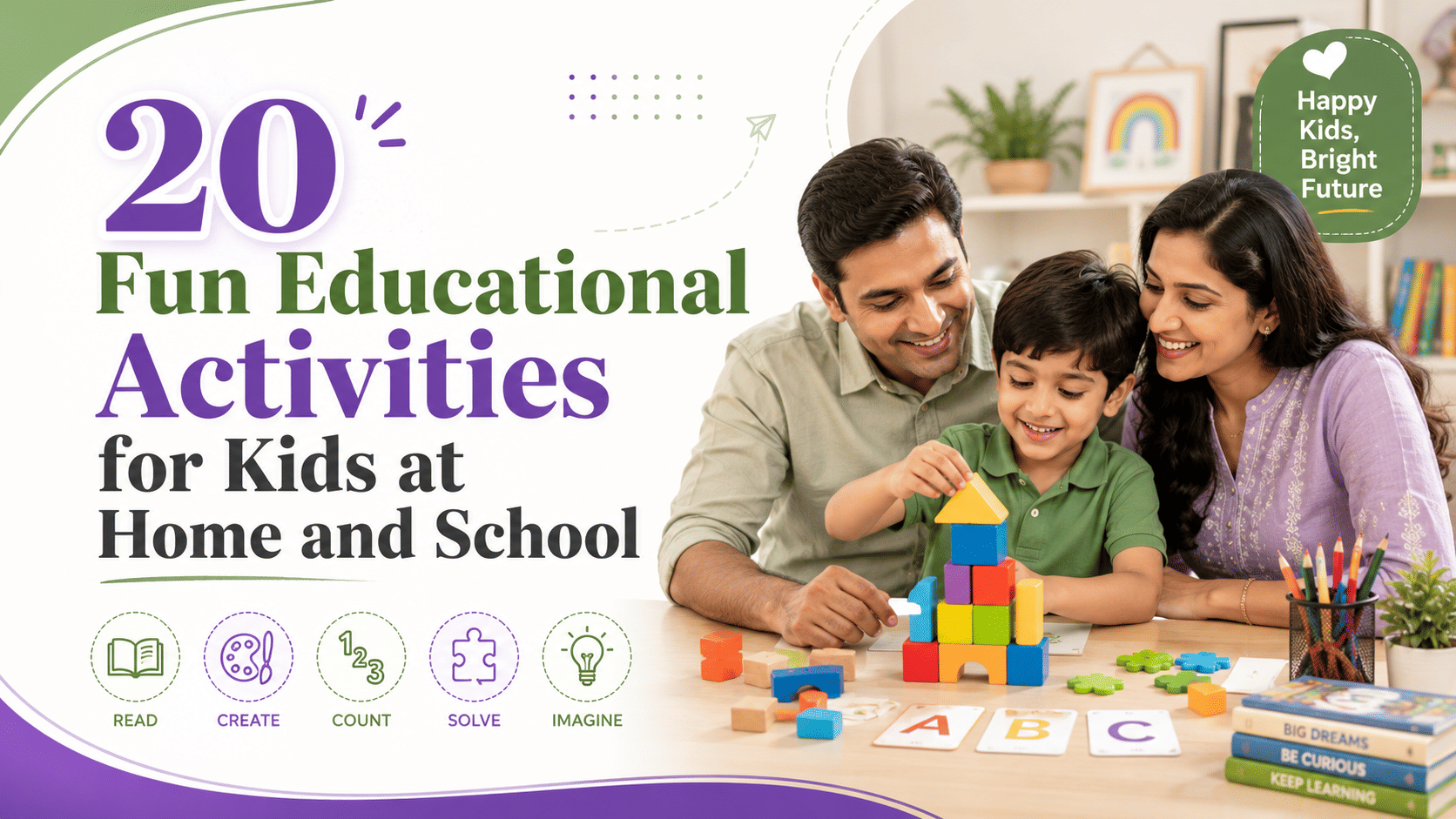
Educational activities for kids work best when children are actively doing something: sorting, building, reading, measuring, observing, speaking or creating. The activity does not have to feel like a lesson. A treasure hunt can practise problem-solving, cooking can introduce measurements, and storytelling can strengthen vocabulary and imagination.
The ideas below use common household materials and can be adapted for pre-primary and primary-school children. Choose activities according to your child’s age, interests and learning level rather than trying to complete every idea.
How to Choose the Right Educational Activity
For children aged 3 to 5, keep instructions short and focus on colours, shapes, sounds, movement and sensory play. Children aged 5 to 7 can handle simple rules, counting, phonics, sequencing and guided experiments. Older primary-school children may enjoy open-ended challenges, journaling, research and activities with multiple steps.
Choose activities that are easy to understand, age-appropriate, active and flexible enough to repeat at a harder level.
Also read:
 Dr. Narendra Babu
Fun Educational Activities for Kids
1. Alphabet Treasure Hunt
Write letters on small cards and hide them around a room. Ask younger children to find a named letter. Older children can collect letters and arrange them into words.
2. Rhyming Word Game
Say a word such as “cat” and take turns naming words that rhyme with it. Use picture cards when children need help.
3. Story-Building Cards
Create separate cards for characters, places and objects. Let the child pick one from each group and invent a story. Ask what happened first, next and last.
4. Home Library Challenge
Let children choose a small reading goal for the week. After each book, they can draw a favourite scene, describe a character or retell the story.
5. Picture-Word Matching
Use homemade or printed cards showing familiar objects and their names. Children can match each picture with the correct word. Older children can use the word in a sentence.
6. Count and Sort Household Objects
Use buttons, spoons, blocks, bottle caps or toy animals. Ask children to sort them by colour, size, shape or type and count each group.
7. Shape Hunt
Walk through the house or neighbourhood and look for circles, rectangles, squares and triangles. Children can photograph or draw what they find.
Kids Audio Stories at Little Joys - Read here
8. Make a Pretend Shop
Label toys or household items with simple prices and use play money. Younger children can recognise numbers, while older children can practise addition, subtraction and making change.
9. Measuring in the Kitchen
While preparing a simple snack, let children count ingredients, compare quantities and use cups or spoons. Adult supervision is essential around heat and sharp tools.
10. Build the Tallest Tower
Give children blocks, paper cups or small boxes and ask them to build the tallest free-standing tower possible. If it falls, encourage them to change the base and try again.
11. Sink-or-Float Experiment
Collect a few safe objects made from different materials. Before placing each item in water, ask the child to predict whether it will sink or float and record the result.
12. Colour-Mixing Lab
Provide red, blue and yellow paint and let children test what happens when two colours are mixed. They can create a simple colour chart.
13. Seed-Growing Journal
Plant a fast-sprouting seed in a transparent cup or small pot. Ask the child to observe and draw it every few days. Older children can measure its height.
14. Nature Scavenger Hunt
Prepare a list of things to find, such as a rough leaf, a smooth stone or something yellow. Avoid touching unknown plants or animals.
15. Recycled-Material Craft
Collect clean boxes, paper rolls, cartons and scraps. Give children a broad challenge, such as designing a vehicle, house or desk organiser.
16. Puppet Storytelling
Make simple puppets from paper bags, socks or paper cut-outs. Children can retell a familiar story or create their own dialogue.
Dr. Vishal
17. Music Pattern Copy
Clap or tap a short rhythm and ask the child to repeat it. Gradually make the pattern longer, then let the child create one.
18. Movement Instructions Game
Give instructions using position and action words: “Take two steps forward,” “stand behind the chair” or “jump beside the mat.”
19. Family Interview
Help the child prepare five questions for a family member about school, games or daily life in the past. They can write, draw or record the answers.
20. Design a Board Game
Ask older children to create a path, rules, challenge cards and a way to win. The theme can be maths, vocabulary, animals or general knowledge.
Educational Activity Books for Kids
Educational activity books can be useful for quiet practice, travel or days when parents have limited preparation time. Look for an appropriate difficulty level, readable pages, varied tasks and a gradual increase in challenge.
For younger children, tracing, matching, mazes, colouring and picture puzzles are easier to use independently. Older children may prefer logic puzzles, word games, science challenges and project-based books.
Nisha Shah
An activity book should support hands-on learning rather than replace it. A worksheet about plants becomes more meaningful when paired with planting a seed, while a measurement page can lead into cooking or measuring furniture.
How to Keep Learning Activities Enjoyable
Start with 10 to 20 minutes and stop before the child becomes frustrated. Offer two choices instead of assigning an activity without discussion. Give help with setup, but avoid correcting every small mistake. Asking “What could you try next?” often encourages more thinking than giving the answer.
Repeat successful activities with one change. A colour-sorting game can later become sorting by size, material or function.
Frequently Asked Questions
What are the best educational activities for kids at home?
Simple, age-appropriate and active options work well. Reading games, sorting, pretend shops, science experiments, cooking, gardening, puzzles and storytelling can turn everyday materials into learning opportunities.
Which activities are suitable for pre-primary students?
Tracing, rhyming, picture matching, colour sorting, counting objects, connecting dots, music, movement games and simple sensory crafts are suitable starting points.
How often should children do educational activities?
There is no fixed number. Short, regular sessions that fit naturally into play and family routines are usually easier to sustain than long home lessons.
Are online educational activities useful?
They can be useful when the content matches the child’s level and requires participation rather than passive watching. Balance them with reading, movement, conversation and hands-on play.
Conclusion
Educational activities for kids do not require expensive kits or a classroom-style setup. The most useful ideas connect learning to things children already enjoy: stories, movement, nature, building, food and imaginative play. Start with one or two activities, notice what holds your child’s attention and adjust the difficulty as their skills grow.