
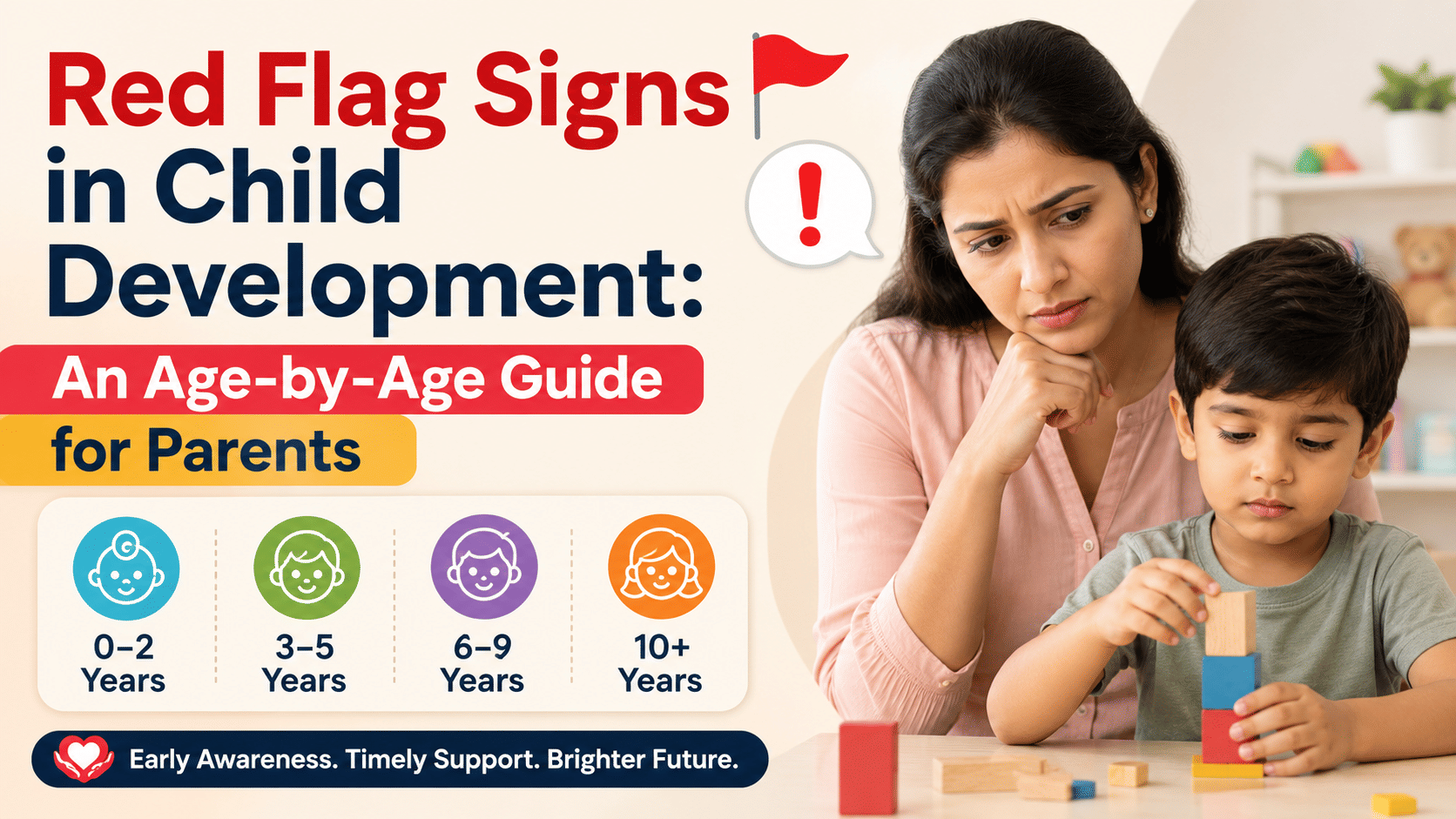
Red Flag Signs in Child Development: An Age-by-Age Guide for Parents
Children do not all smile, speak, walk or play at exactly the same age. Development occurs across a range, and a child can move more quickly in one area than another.
However, certain patterns can indicate that a child needs developmental screening or a more detailed assessment. These are commonly called red flag signs in child development.
A red flag is not a diagnosis. It is a reason to look more closely, particularly when:
- A child loses a skill they previously used.
- Several areas of development appear delayed.
- Progress has stopped for an extended period.
- A difficulty affects eating, moving, communicating, playing or everyday participation.
- A parent, caregiver or teacher remains concerned.
CDC advises parents not to wait when a child is missing milestones, has lost skills or is developing in a way that causes concern.
Red Flags That Need Attention at Any Age
Some concerns matter regardless of the child’s exact age:
- Loss of previously acquired skills, such as stopping words, gestures, play or movements the child previously used.
- Marked difference between the two sides of the body, including persistent one-sided weakness or movement.
- Very stiff or very floppy muscle tone that affects movement or daily activities.
- Little or no response to sound or visual stimuli.
- Persistent feeding or swallowing difficulty.
- Poor interaction or engagement that significantly affects everyday participation.
- A strong, continuing concern from a parent or caregiver.
Children’s Health Queensland places skill loss, strong parental concern, lack of response to sound or visual input, marked muscle-tone differences and body asymmetry in its “red flags at any age” category.
Sudden skill loss or a child who is acutely unwell should be discussed with a medical professional promptly.
 Little Joys
What Are Developmental Milestones?
Developmental milestones are skills that most children can perform by a particular age. They provide useful reference points in several areas:
Gross motor development
Large movements such as holding the head steady, sitting, standing, walking, running and jumping.
Fine motor development
Using the hands and fingers to reach, grasp, transfer objects, feed, scribble, draw and manipulate small items.
Language and communication
Making sounds, understanding words, using gestures, speaking and participating in conversation.
Cognitive development
Learning, remembering, solving problems, finding hidden objects and using toys purposefully.
Little Joys
Social and emotional development
Smiling, interacting, taking turns, showing emotions, sharing attention and playing with other people.
CDC defines milestone checklists as monitoring resources based on skills that most children-approximately 75% or more-can do by the listed age. The checklists are not substitutes for validated developmental screening tools.
Developmental Red Flags by Age
The age bands below are guides, not tools for diagnosing a condition. The child’s medical history, corrected age, hearing, vision, progress and everyday functioning all matter.
Birth to 4 Months
Discuss the child’s development with a clinician when the baby:
- Rarely responds to loud sounds.
- Does not look at faces or track moving objects.
- Is not beginning to smile socially by about 2–3 months.
- Shows very poor head control by around 4 months.
- Moves one side much less than the other.
- Appears unusually stiff or floppy.
- Has persistent difficulty sucking, feeding or swallowing.
- Makes no sounds other than crying as the early months progress.
Current CDC checklists include reacting to loud sounds, looking at faces, watching movement, smiling responsively, making sounds and beginning to control the head among early developmental expectations.
Around 6 Months
Possible red flag signs of development include:
- Poor head control.
- Not reaching for available objects.
- Not bringing objects towards the mouth.
- No laughter, squealing or vowel-like sounds.
- Little response to caregivers or nearby sounds.
- Not rolling in either direction alongside other motor concerns.
- Very tight or very floppy muscles.
- Persistent eye turning, unusual eye movements or difficulty following objects.
One isolated variation does not establish a delay. The overall pattern and whether the child is continually gaining skills are more important.
Around 9 Months
Arrange a developmental discussion when the baby:
- Cannot sit without support.
- Does not respond to their name.
- Does not make repeated sounds such as “bababa” or “mamama.”
- Shows little interest in back-and-forth games.
- Does not transfer an object from one hand to the other.
- Does not look towards an object when someone points.
- Does not recognise familiar caregivers.
- Cannot bear some weight through the legs when supported.
- Shows no purposeful way of moving or exploring.
CDC’s current 9-month checklist includes responding to one’s name, varied babbling, enjoyment of peek-a-boo, sitting unsupported, transferring objects and looking for dropped items.
Eleven-Month Milestone Red Flags
There is no separate universal CDC milestone checklist for exactly 11 months. At this age, parents can look at whether the child has established the main 9-month skills and is progressing towards skills commonly seen around the first birthday.
Speak with the child’s clinician about an 11-month-old who:
- Is not sitting independently.
- Does not babble using repeated or varied sounds.
- Rarely responds to their name, voices or other sounds.
- Does not engage in simple social games.
- Does not use early gestures or attempt to communicate.
- Does not transfer, grasp or purposefully explore objects.
- Cannot bear weight on the legs when held.
- Shows no progress towards pulling up or supported standing.
- Uses one side much more than the other.
- Is markedly stiff or floppy.
- Has lost any skill.
By one year, CDC lists playing interactive games, waving, using a special name for a parent, understanding “no,” finding a hidden object, pulling to stand, moving along furniture and using a thumb-and-finger grasp among common milestones.
Is not crawling at 11 months always a red flag?
No. Some babies crawl on hands and knees, while others roll, scoot, bottom-shuffle or move in another way. Current CDC checklists do not require conventional crawling as a standalone milestone.
The more relevant questions are whether the baby:
- Sits independently.
- Uses both sides of the body.
- Explores and moves purposefully.
- Bears weight through the legs.
- Continues gaining mobility.
Children’s Health Queensland focuses on the absence of any form of independent mobility around the first birthday rather than requiring one specific crawling style.
Around 12 to 18 Months
Discuss assessment when the child:
- Does not point, show, wave or use other communicative gestures.
- Does not respond consistently to their name or familiar words.
- Has no meaningful words as the child moves through this period.
- Does not imitate simple actions or sounds.
- Does not use familiar objects purposefully.
- Cannot pull to stand or bear weight with support around the first birthday.
- Is not walking independently by 18 months.
- Makes no progress in language, social interaction or movement.
- Loses previously acquired skills.
The official Indian developmental-red-flag table lists no pointing or pincer grasp at 12 months, no single words at 18 months and inability to walk independently at 18 months as reasons for evaluation.
Around 18 to 24 Months
Possible red flags include:
- Not walking steadily.
- Walking only on the toes or showing a persistently unusual gait.
- Not following a simple instruction.
- Not imitating familiar actions.
- Not using words to communicate needs.
- Not combining two meaningful words by around age 2.
- Little interest in simple pretend play.
- Not understanding what common objects are used for.
- Little shared attention, such as pointing to show something interesting.
- Loss of words, gestures, play or motor skills.
CDC’s 2-year checklist includes combining at least two words, using gestures, noticing when someone is upset, playing with more than one toy and running. Parents are advised to act early whenever milestones are missing or skills have been lost.
Ages 2 to 3 Years
Consider professional advice if the child:
- Does not communicate in short phrases.
- Has significant difficulty understanding simple instructions.
- Is difficult for familiar caregivers to understand most of the time.
- Shows no pretend or imaginative play.
- Rarely shows interest in interaction with adults or children.
- Falls very frequently or cannot run and jump as expected for their stage.
- Has major difficulty using simple toys or small objects.
- Does not attempt age-appropriate self-care activities.
- Displays persistent feeding, chewing or swallowing problems.
- Loses a previously used skill.
At this age, social interest and play styles vary considerably. Shyness, preferring occasional solitary play or having a tantrum does not by itself diagnose a developmental condition.
Ages 3 to 5 Years
A preschool assessment may be useful when a child:
- Cannot use simple sentences to communicate needs.
- Has speech that remains very difficult to understand.
- Cannot follow age-appropriate one- or two-step directions.
- Shows no interest in pretend play.
- Has persistent difficulty interacting or playing cooperatively.
- Frequently falls or struggles markedly with stairs, running or jumping.
- Cannot manipulate crayons, blocks or other common play materials.
- Has significant difficulty feeding, dressing or completing everyday routines.
- Cannot participate in conversation at an age-appropriate level.
- Shows behaviour that seriously affects safety, learning or daily family life.
- Loses skills.
Queensland’s guide includes communication, cooperative play, drawing,
self-care, ball skills and confident movement when considering functional development between ages 3 and 5.
Remember Corrected Age for Premature Babies
A baby born early should not always be compared with milestones using chronological age alone.
Corrected age is calculated by subtracting the number of weeks the baby was born early from the baby’s chronological age. The American Academy of Pediatrics advises using corrected or adjusted age when tracking a preterm child’s development during the first two years.
For example, an 11-month-old baby born eight weeks early has a corrected age of approximately nine months. Their clinician will consider both dates, their medical history and their rate of progress.
Corrected age should not be used to dismiss regression, marked asymmetry, feeding difficulty or a parent’s concern.
What Can Be Behind a Developmental Concern?
A red flag does not identify the cause. Similar developmental patterns may be associated with very different circumstances, including:
- Hearing or vision difficulty
- Premature birth
- Motor or muscle-tone differences
- Speech or language difficulties
- Neurological conditions
- Genetic or medical conditions
- Broader developmental differences
This is why a checklist cannot replace evaluation. Clinicians may assess milestones, muscle tone, hearing, vision, feeding, communication, play, behaviour and medical history before deciding which tests or referrals are appropriate.
A red flag should also not be used by itself to label a child with autism, ADHD, cerebral palsy or another condition.
What to Do When You Notice a Red Flag
1. Record what you are seeing
Write down:
- The skill causing concern
- When you first noticed it
- How often it occurs
- Whether the child has ever used the skill
- Whether the concern appears in more than one setting
- Any related feeding, hearing, vision, sleep or movement concerns
Short home videos may help demonstrate a movement, interaction or communication pattern that does not appear during an appointment.
2. Talk to the child’s paediatrician
Describe the specific behaviour rather than saying only that the child seems “behind.”
For example:
“At 11 months, she sits independently but does not babble, turn towards her name or use gestures.”
This gives the clinician more useful information.
3. Ask about standardised screening
Milestone checklists help families monitor development, but they are not the same as validated screening tools. Ask whether a formal developmental screen is appropriate.
4. Consider hearing and vision
A child who does not respond to their name may have a hearing difficulty, a communication difference or another explanation. A child who does not reach accurately, read pictures or navigate spaces may require vision assessment.
Do not assume that every communication concern is behavioural.
5. Follow recommended referrals
Depending on the concern, referrals may include:
- Developmental paediatrics
- Paediatric neurology
- Audiology
- Ophthalmology or optometry
- Speech and language therapy
- Physiotherapy
- Occupational therapy
- Feeding services
- Early-intervention programmes
Not every child needs every service.
6. Do not wait for a final diagnosis to ask about support
Early-intervention services are often based on the child’s functional needs. Evaluation and appropriate support can begin while the cause is still being clarified.
Supporting Development at Home
Home activities cannot replace screening or therapy, but responsive everyday interaction supports learning.
Useful habits include:
- Talking through daily routines
- Reading and discussing pictures
- Singing songs with gestures
- Playing face-to-face turn-taking games
- Providing safe floor-based movement opportunities
- Letting the child reach, grasp and explore
- Offering age-appropriate pretend play
- Allowing the child to attempt self-feeding and dressing
- Following the child’s interests during play
- Limiting passive screen use
- Celebrating attempts rather than demanding perfect performance
Children’s Health Queensland recommends partnering with the child in play, following their lead, adjusting play to their level and gradually introducing new ideas.
Common Mistakes to Avoid
“Every child develops differently, so we should simply wait”
Variation is real, but it should not be used to ignore loss of skills, significant functional difficulty or sustained parental concern.
Comparing only with siblings
Siblings can develop at very different rates. Use recognised developmental guidance and professional screening rather than one family member as the standard.
Focusing only on walking and talking
Development also includes hand use, hearing, vision, understanding, social interaction, play and self-care.
Treating one checklist as a diagnosis
A checklist indicates whether further discussion may be helpful. It does not establish why a child is developing differently.
Assuming a late talker will automatically catch up
Some late-talking children progress without extensive intervention, while others have hearing, language or broader developmental needs. Screening helps distinguish these possibilities.
Waiting until school begins
The AAP recommends formal developmental screening well before school age and whenever concerns arise.
Frequently Asked Questions
What is a red flag sign in paediatrics?
A red flag sign in paediatrics is an observation suggesting that a child may need closer medical or developmental assessment. It is an alert for evaluation, not proof of a particular diagnosis.
Does one red flag mean that a child has a developmental disorder?
No. One sign may result from normal variation, temporary illness, limited opportunity to practise, hearing or vision difficulty, prematurity or another factor.
However, one significant sign-especially regression, marked asymmetry or inability to function-can be enough to justify professional assessment. Queensland’s guide recommends considering functional impact and parental concern rather than simply counting red flags.
What are the main 11-month milestone red flags?
Important concerns include no independent sitting, no babbling, little response to name or sound, no interactive play, no gestures, poor purposeful hand use, inability to bear weight with support, marked stiffness or floppiness, major asymmetry or any loss of skills.
An 11-month-old does not necessarily need to crawl in one particular way.
When should a child receive developmental screening?
AAP guidance recommends standardised general developmental screening at 9, 18 and 30 months, autism screening at 18 and 24 months, and additional screening whenever concerns arise.
Is a milestone checklist the same as a developmental test?
No. A checklist helps monitor skills. A standardised screening tool has been formally developed and validated to identify children who may require further evaluation.
Who evaluates developmental delay?
The first discussion is commonly with a paediatrician. Depending on the pattern, assessment may involve developmental paediatrics, neurology, audiology, speech-language therapy, physiotherapy, occupational therapy, vision services or another specialist.
Does not crawling mean a child has delayed development?
Not necessarily. Children may crawl, scoot, roll, bottom-shuffle or move in another way. More concerning patterns include no purposeful mobility, inability to sit, failure to bear weight, asymmetry, abnormal tone or lack of progress across several skills.
Is loss of skills always concerning?
Loss of previously acquired language, movement, play or social skills should be discussed promptly with a healthcare professional. Both CDC and government red-flag guides treat regression as an important reason to act early.
Final Takeaway
Developmental milestones occur within ranges, not on one exact date. A child who is slightly later with one skill is not automatically delayed.
The patterns that deserve closer attention are skill loss, persistent lack of progress, differences across several developmental areas, major muscle-tone or movement abnormalities, limited response to sound or people, and difficulties that affect daily life.
Parents do not need to diagnose the cause before requesting help. Record the concern, discuss it with the child’s paediatrician and ask whether standardised screening or a specialist referral is appropriate. Early action provides information and support-it does not place a label on the child.
This article provides general education and cannot evaluate an individual child. Discuss developmental concerns with a paediatrician or another qualified child-development professional.