
High-Protein Vegetarian Breakfasts Kids Will Actually Eat
Most Indian breakfasts a child happily eats - poha, upma, a plain paratha, cereal with milk - are built on carbohydrate with protein as an afterthought. That is the gap worth closing, and breakfast is the easiest place to close it, because it is the one meal where a small change repeats every single day. Fix breakfast and you have done more for a vegetarian child's protein than any amount of worrying at dinner.
 Little Joys
The good news is that vegetarian Indian cooking is already full of protein; it just tends to show up at lunch and dinner, in the dal and the rajma, rather than first thing. Pull some of it forward to the morning and the day starts even. None of what follows needs eggs, and none of it needs a special recipe.
The workhorses are besan and dal, because they turn into breakfast kids like. A besan chilla or a moong dal chilla is essentially a savoury pancake with real protein in it, and most children will eat it rolled up in their hand. A paneer paratha does the same job in a form that already lives in most kitchens. Idli and dosa lean more carbohydrate, but served with a proper dal-heavy sambar - or with the batter made with extra dal - they pull their weight. Even humble dalia (broken wheat) cooked in milk, with a spoon of crushed nuts on top, is a far better protein start than the same bowl made with water.
Then the quick add-ons that lift an ordinary breakfast without a new recipe. A bowl of curd or a glass of milk alongside whatever is on the plate. A handful of soaked and chopped nuts over the dalia or into a smoothie. Sprouts, steamed and lightly chaat-ed, for the kids who will take them. Peanut butter on a wholegrain toast. These are not breakfasts on their own for most children, but bolted onto one, they move the number up.
The one trick worth knowing, because it does real work, is combining. Cereals and pulses each miss some of the amino acids a body needs, but together they cover each other - which is exactly what a lot of traditional pairings already do. Idli with sambar, khichdi, dosa with dal, roti with a side of chana: the pairing is not a coincidence, it is complementary protein, and leaning on it is the single most useful habit for a vegetarian child.
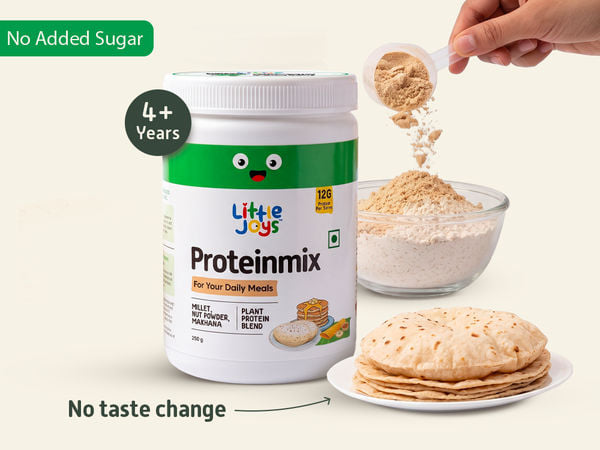
For the mornings when the plate is still coming up short - a selective eater, a rushed day, a child who refuses half the list above - a mix-in can quietly top up the protein in food they already accept. Little Joys Proteinmix is an unflavoured, plant-based blend (pea, brown rice and soy, with almond, jowar and makhana) made to be stirred into chilla batter, dalia or the atta for a paratha, so breakfast stays the breakfast and simply carries more protein. It is for ages 4 and up, has no added sugar, and is naturally gluten-free; it contains soy and nut, so check the label if allergies are a factor. Think of it as a top-up for the short mornings, not a replacement for the dal and curd doing the main job.
Little JoysPull some protein forward to breakfast, lean on the cereal-and-pulse pairings you already cook, and the vegetarian protein question mostly answers itself.
Frequently asked questions
What are high-protein vegetarian breakfasts for kids?
Besan or moong dal chilla, paneer paratha, idli or dosa with a dal-rich sambar, dalia cooked in milk with nuts, and anything paired with curd or milk. These bring real protein without eggs or meat.
How can I add protein to my child's breakfast without a new recipe?
Add a glass of milk or bowl of curd, stir crushed nuts into porridge, serve a dal-heavy sambar with idli, or use an unflavoured protein mix in chilla batter or atta. Small additions to familiar food work better than new dishes.
Do vegetarian kids get enough protein at breakfast?
Often not, because popular Indian breakfasts are carbohydrate-heavy. The fix is to front-load some protein - dal, besan, dairy, nuts - and to pair cereals with pulses, which together provide more complete protein.
Is a protein mix necessary for breakfast?
Not for most kids eating a varied diet with dal, dairy and nuts. A mix-in can help a selective or vegetarian eater aged 4+ who is falling short - as a top-up to real food, ideally after trying the food-first routes above.