
Jaggery vs White Sugar for Kids: Which Is Better?
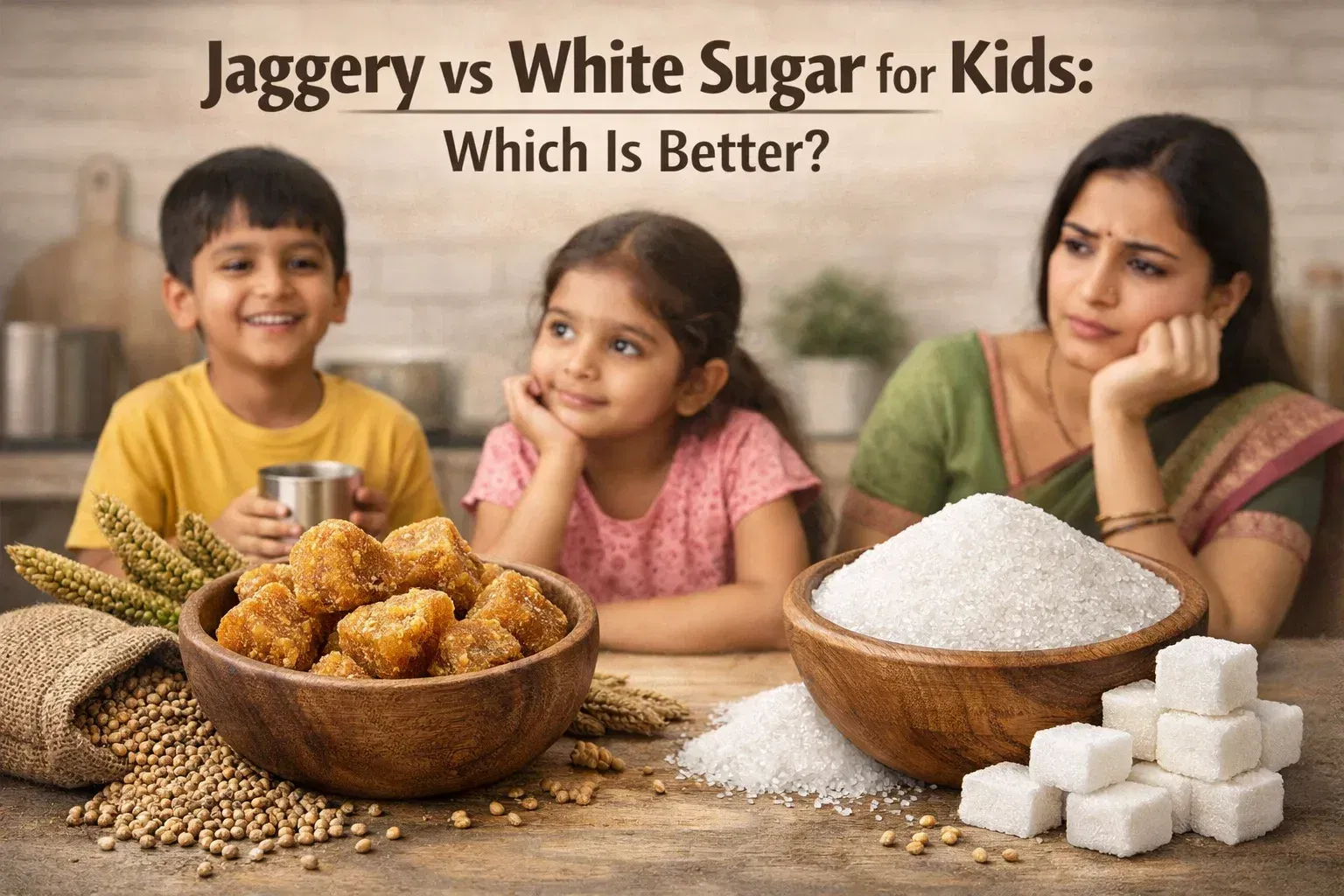
Most Indian parents intuitively prefer jaggery over white sugar for their children. The reasoning is usually vague - it is "more natural" or "traditional." But the actual nutritional difference is more specific and more significant than most people realise.
Here is a clear breakdown of what sets the two apart, and why it matters for children in particular.
What Is White Sugar and What Does It Do?
White sugar (refined sucrose) is produced by processing sugarcane or beet juice through multiple stages of filtration, heating, and crystallisation. The end product is almost pure sucrose - around 99.7% - with virtually all naturally occurring minerals, vitamins, and fibre removed.
In the body, refined sugar is absorbed rapidly, causing a quick spike in blood glucose followed by a sharp drop. This cycle promotes energy crashes, increased hunger, and - over time - insulin resistance when consumed in excess. In children, the effects are visible: the afternoon energy slump after a sugary school snack, the hunger that returns quickly, the difficulty focusing in later school hours.
Beyond energy, refined sugar actively disrupts gut health. Harmful bacteria and yeasts thrive on sugar, outcompeting beneficial species. Daily sugar intake from seemingly small sources - a biscuit, a sweetened milk drink, a sugar-based vitamin gummy - accumulates and consistently shifts the gut microbiome in the wrong direction.
What Is Jaggery and How Is It Different?
Jaggery (gur) is produced by boiling raw sugarcane juice or palm sap and allowing it to solidify without the refining process. Because it is unrefined, the natural minerals present in sugarcane remain intact.
Key nutrients in jaggery (per 100g):
- Iron: 11 mg - meaningful for children prone to iron deficiency
- Potassium: 1056 mg - supports fluid balance and nerve function
- Magnesium: 70-90 mg - supports sleep, muscle relaxation, and over 300 enzymatic processes
- Calcium: 80 mg - contributes to daily bone-building requirements
- Small amounts of B vitamins
Jaggery is still predominantly sugar (around 65-85% sucrose and reducing sugars), so it should not be treated as a health food consumed freely. But unlike refined sugar, it comes with a nutritional matrix rather than being nutritionally empty.
Glycaemic Index: Does Jaggery Spike Blood Sugar Less?
Jaggery has a slightly lower glycaemic index (GI) than white sugar - approximately 84 vs 100 for white sugar. The difference is meaningful but not dramatic. Jaggery still raises blood glucose; it does so slightly more slowly.
For children with blood sugar regulation concerns, the difference in GI provides a modest benefit. For most children, the more important factor is simply using less sweetener overall - of either kind.
Why Jaggery Is the Better Choice for Kids
1. It provides iron - particularly relevant for Indian children, among whom iron deficiency is the most widespread nutritional deficiency. Even small daily amounts of jaggery in porridge, dal, or roti add up to a meaningful iron contribution over time.
2. It causes less gut disruption - jaggery's natural mineral content and lower refinement mean it feeds gut bacteria less aggressively than pure refined sucrose. It is not a prebiotic, but it is less disruptive to the microbiome than white sugar.
3. It avoids the empty-calorie problem - white sugar adds calories with no nutritional return. Every gram of jaggery consumed in place of white sugar delivers at least trace minerals alongside the calories.
4. It is compatible with traditional Indian cooking - jaggery works in dal, khichdi, porridge, ladoos, and milk drinks without changing the flavour profile meaningfully. Transitioning a household from white sugar to jaggery is practically seamless in Indian cooking.
Where Jaggery Already Features in Quality Kids' Products
Beyond cooking, jaggery is increasingly used in well-formulated children's nutrition products as a natural sweetener in place of refined sugar.
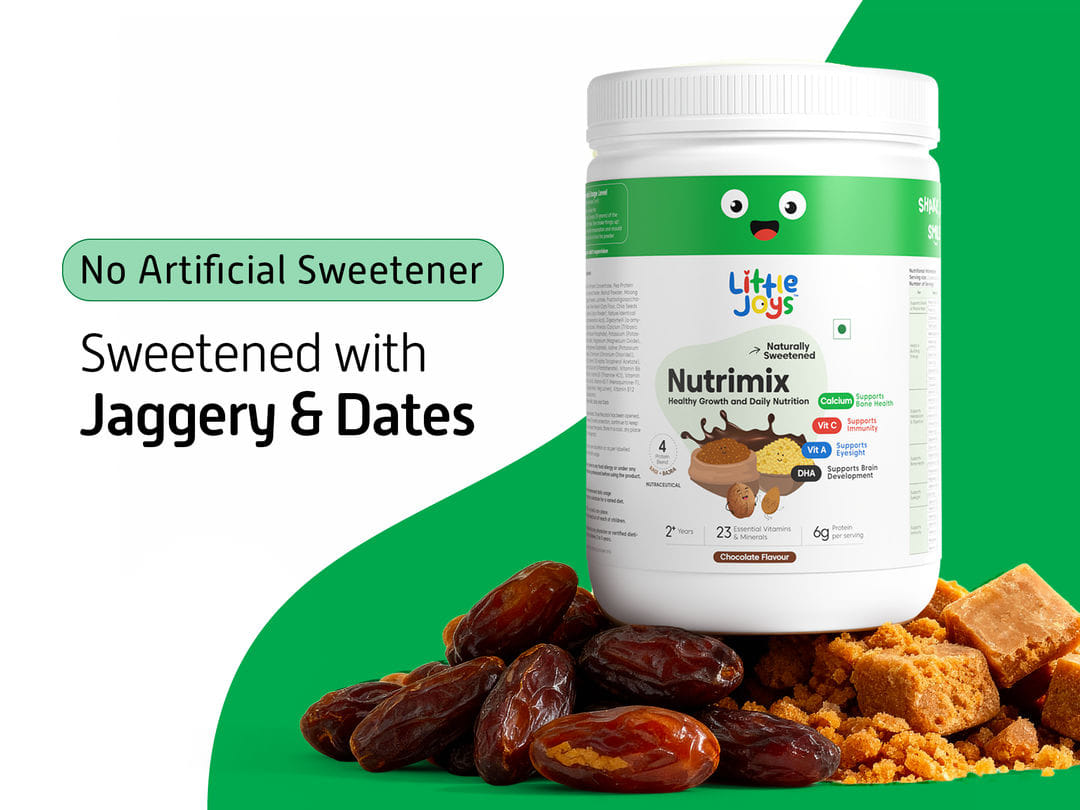
Little Joys NutriMix uses jaggery and dates as the only sweeteners - no refined sugar, no glucose syrup, no artificial sweeteners. The combination delivers natural sweetness alongside the iron from jaggery and the fibre and natural sugars from dates, making it a nutritionally meaningful choice rather than a label-friendly substitution.
FAQ
Q: Can I replace all white sugar with jaggery in my child's diet?
Yes - jaggery works as a direct substitute in most Indian cooking and baking. The flavour is slightly more complex and caramel-like, which most children accept readily.
Q: How much jaggery is safe for children daily?
There is no established upper limit specific to jaggery for children, but the principle of moderation applies. A few teaspoons per day across meals is appropriate. The goal is not unlimited jaggery but replacing refined sugar with it.
Q: Are jaggery-sweetened products actually better than sugar-sweetened ones?
Yes - in terms of nutritional content and gut impact, jaggery-sweetened products are meaningfully better than refined sugar equivalents, assuming the same total quantity. The key is that the sweetener does not cancel out other nutritional benefits.