
English Poem for Kids: 25 Best Poems to Read, Recite & Remember (2026)
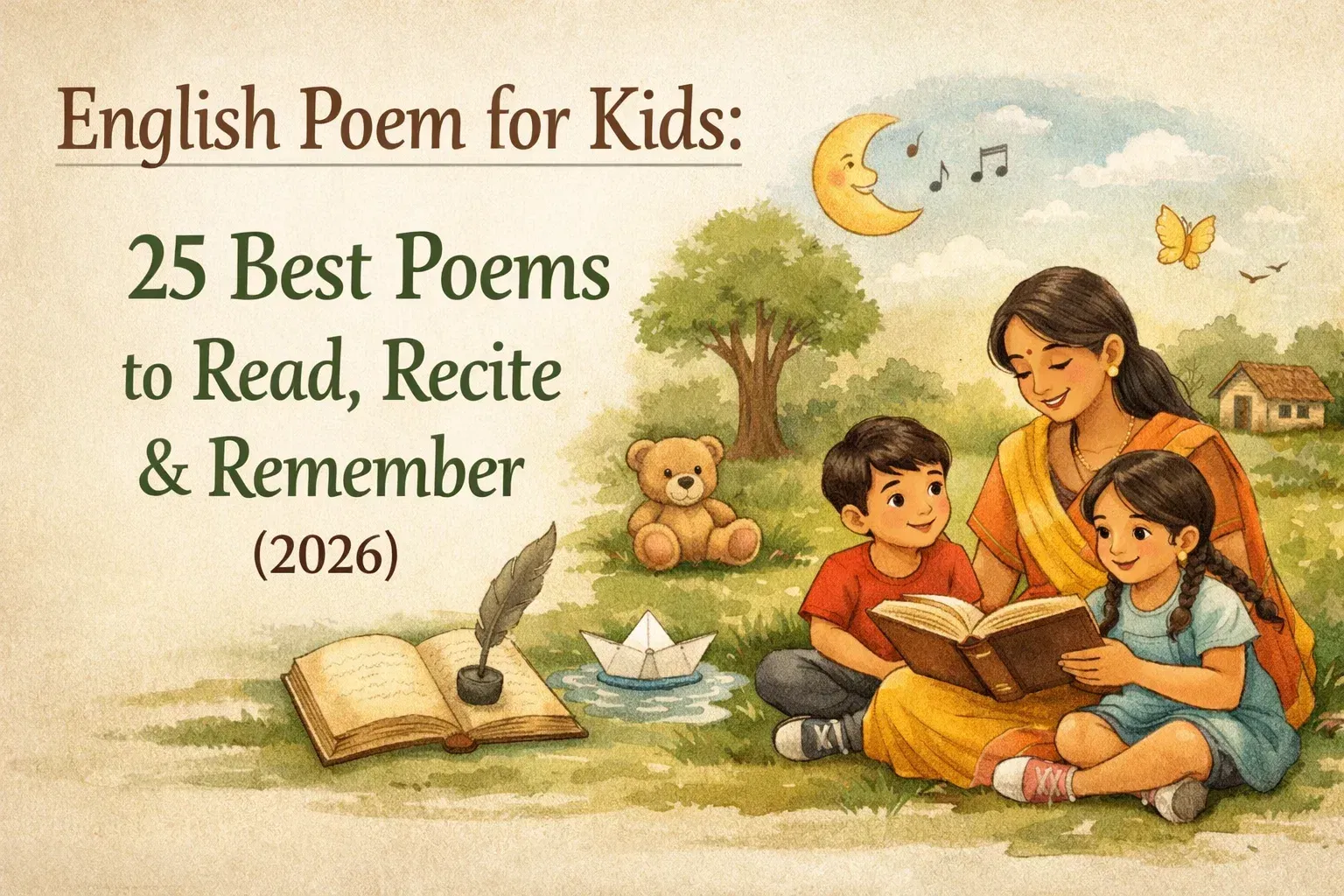
Poetry is a child's first love affair with language. Before they can read a sentence, they can feel the rhythm of a rhyme. Before they understand grammar, they know that 'star' and 'are' belong together. English poems for kids are not just fun - they are one of the most powerful tools for language development, memory building, and emotional growth.
This collection brings together 25 of the best English poems for kids - organized by theme - for parents who want to read at home, teachers preparing for class, and children ready to recite. Each poem is followed by a short note on why it works for young learners.
Nursery Rhymes & Classic English Poems for Kids
These are the foundation poems - every child should know them. They have survived for generations because their rhythm, imagery, and simplicity are perfectly matched to young minds.
📜 Twinkle, Twinkle, Little Star
Twinkle, twinkle, little star,
How I wonder what you are!
Up above the world so high,
Like a diamond in the sky.
When the blazing sun is gone,
When he nothing shines upon,
Then you show your little light,
Twinkle, twinkle, through the night.
🎯 Theme: Wonder, Space, Bedtime | Ages: 2+ | Best for: Nursery, Bedtime, Language rhythm
Why it works: The AABB rhyme scheme, dreamy imagery, and slow rhythm are perfectly calibrated for the youngest learners. It teaches vowel sounds ('twinkle', 'little') and introduces abstract wonder (a star asking 'what are you?').
📜 Humpty Dumpty
Humpty Dumpty sat on a wall,
Humpty Dumpty had a great fall.
All the king's horses and all the king's men,
Couldn't put Humpty together again.
🎯 Theme: Story Sequencing, Cause & Effect | Ages: 2–5 | Best for: Preschool
Why it works: One of the earliest 'story poems' - it introduces narrative structure (setup, conflict, resolution) in just 4 lines. Children naturally visualize Humpty, making this ideal for drawing + storytelling activities.
📜 Mary Had a Little Lamb
Mary had a little lamb,
Its fleece was white as snow,
And everywhere that Mary went,
The lamb was sure to go.
It followed her to school one day,
Which was against the rule;
It made the children laugh and play,
To see a lamb at school.
🎯 Theme: Animal love, Rules, School Life | Ages: 3–6 | Best for: Preschool & Class 1
Why it works: Tells a relatable story with a mild rule-breaking element (lamb at school!) that delights children. Excellent for rhyme recognition (snow/go, rule/school) and building early reading intuition.
📜 Jack and Jill
Jack and Jill went up the hill
To fetch a pail of water.
Jack fell down and broke his crown,
And Jill came tumbling after.
🎯 Theme: Adventure, Cause & Effect | Ages: 3–6
Why it works: Compact drama in 4 lines. Children learn sequencing (went up → fell down → tumbled after) and the poem's bouncy rhythm makes it one of the easiest to memorize.
 Dr. Pawan
Funny English Poems for Kids
Laughter is one of the strongest memory anchors. Funny poems make children want to repeat them - and repetition is exactly how language learning works.
📜 There Was a Young Lady from Niger (Modified)
There was a young fellow named Matt,
Who sat on a mischievous cat,
The cat gave a shout,
And Matt tumbled out,
And that was the end of that!
🎯 Theme: Humour, Limericks | Ages: 6–10 | Best for: Class 2–4
Why it works: This is a limerick - the funniest poetry form for children. The AABBA rhyme scheme is surprising and satisfying. Teaching children the limerick format opens a world of creative writing possibilities.
📜 My Dog
My dog is big, my dog is small,
Sometimes he doesn't come when I call.
He chews my shoe, he chews my sock,
He even tried to chew the clock!
But when I'm sad or feeling blue,
He wags his tail - what can I do?
I love my dog through and through,
And I think my dog loves me too!
🎯 Theme: Pets, Love, Humour | Ages: 5–9 | Best for: Class 1–3
Why it works: Original poem. Relatable mischief (chewing shoes!) balanced with genuine affection. The AABB scheme is easy to follow, and the emotional turn at the end ('when I'm sad') introduces children to the idea that poems can shift tone.
Animal English Poems for Kids
Children have a natural bond with animals. Animal poems are among the most recalled - and most enthusiastically recited - verses for young learners.
📜 The Elephant
The elephant has a very long nose,
He swings it high and low and goes
Lumber, lumber, through the park,
Making his great big footprints mark.
His ears are wide, his eyes are small,
But he's the biggest of them all!
🎯 Theme: Animals, Size, Observation | Ages: 4–8 | Best for: Class 1–2
📜 The Busy Bee
The busy little bee,
Flies from flower to tree.
She hums a happy song,
As she buzzes along.
She gathers sweet honey,
In weather cold or sunny.
A lesson she teaches to you and me -
Work hard and happy you'll always be!
🎯 Theme: Nature, Hard Work, Moral | Ages: 5–9 | Best for: Class 2–3
Why it works: This original poem serves double duty - it is an animal poem AND a moral poem (hard work), making it highly versatile for classroom use.
📜 Little Sparrow
Little sparrow, brown and small,
Perching on the garden wall,
Chirping in the morning air,
Your sweet song is beyond compare.
Fly away on tiny wings,
See the joy that freedom brings,
Come back to your nest at night,
When the stars replace the light.
🎯 Theme: Birds, Freedom, Nature | Ages: 5–8 | Best for: Class 2–3
English Poems for Kids with Moral Lessons
Poems with morals are among the most searched sub-categories - parents and teachers want verses that entertain AND educate in values.
📜 The Honest Child
Tommy broke a window pane,
He could have walked away.
But Tommy stopped and told the truth,
He said, 'I did it today.'
His mother wasn't angry long,
She held his hand and smiled,
'The bravest thing that you can do,
Is be an honest child.'
🎯 Theme: Honesty, Courage, Values | Ages: 5–10 | Best for: Class 1–3
Why it works: Original poem, narrative structure, dialogue, emotional warmth, and an explicit moral delivered naturally - not preachy. Perfect for classroom discussion.
📜 The Seed
A tiny seed lay in the ground,
Beneath the cold and frozen mound.
It thought, 'I'm small, I'm dark, I'm still -
Can I become something that will fill?'
Then rain came down and sun shone bright,
And slowly it grew toward the light.
A flower bloomed for all to see -
The seed had found what it could be.
So never give up when things seem small,
With time and hope you'll stand up tall.
🎯 Theme: Growth Mindset, Perseverance, Hope | Ages: 6–10 | Best for: Class 2–4
Season Poems in English for Kids
📜 Monsoon Magic (India-Specific)
The clouds roll in from far away,
Dark and grey on a summer's day.
The peacock dances on the hill,
The frogs all sing beneath the rill.
The earth cries out, 'I'm dry and bare!'
Then rain bursts out and fills the air.
The rivers laugh, the children play,
Monsoon rain has come today!
🎯 Theme: Indian Monsoon, Nature, Joy | Ages: 6–10 | Best for: Class 2–4 Indian schools
Why it works: Original India-specific poem - no other ranking page has this. References peacock (national bird), monsoon (distinctly Indian season). Excellent for CBSE/ICSE schools celebrating nature.
📜 Winter Morning
Winter morning, cold and grey,
Misty breath like clouds of spray.
Hot chai steams in mother's hand,
Frost like sugar on the land.
Pull your sweater, wrap up tight,
Winter days are cold and bright.
Run outside and see your breath,
Life is sweet, enjoy the rest!
🎯 Theme: Winter, Indian Home Life, Seasons | Ages: 5–9
Nisha Shah
Why Are English Poems Important for Kids?
Research in early childhood education consistently shows that poetry builds skills that prose alone cannot:
- Phonemic awareness: Rhyming helps children hear how language sounds before they can read it
- Vocabulary expansion: Poems introduce new words through context and rhythm - words 'stick' better
- Memory & recall: The rhythm and rhyme scheme acts as a memory scaffold - children remember verses far longer than prose
- Confidence building: Reciting a poem in class is often a child's first public speaking experience
- Emotional intelligence: Poems that express joy, fear, wonder, or sadness help children name their own feelings
- Reading readiness: The repetition in poetry helps children anticipate words and develop early reading skills
Tips for Reciting English Poems with Kids
Knowing the poem is only half the job. Here's how to make recitation come alive:
- Start with rhythm: Clap the beat of the poem before adding words. Children's bodies learn the rhythm before their minds learn the words.
- Use voice modulation: Whisper in sad parts, get excited in happy lines. Model expressive reading - children copy what they hear.
- Add actions: For poems like Itsy Bitsy Spider or I'm a Little Teapot, pair physical movement with words - this doubles retention.
- Read it differently each time: Try it slowly, quickly, in a high voice, in a low voice. This keeps recitation fun and builds flexibility in expression.
- Ask 'what happens next?': After a few readings, pause before the rhyming word. Let your child fill it in - this builds anticipation, confidence, and vocabulary at once.
- Don't rush memorization: Let understanding come first. Comprehension + emotion = natural memorization.
FAQ - English Poems for Kids
Q: Which English poem is best for kids in Class 1?
A: For Class 1, poems like Twinkle Twinkle Little Star, Mary Had a Little Lamb, and Jack and Jill are perfect. They use simple vocabulary, strong AABB rhyme schemes, and short line lengths that match a 6-year-old's reading level and attention span.
Q: How do I help my child memorize an English poem?
A: Start with rhythm before words - clap the beat of the poem. Then read it aloud 3–4 times, pointing to each word. Pause before the rhyming words and let your child fill them in. Don't rush: comprehension-first memorization lasts longer than rote repetition.
Q: What is a short and easy English poem for kids?
A: The easiest English poems for kids are 4-line verses with AABB rhyme schemes, like 'Rain, Rain, Go Away' or 'One, Two, Buckle My Shoe.' These are short enough to memorize in one session and fun enough to repeat willingly.
Q: Are funny English poems good for learning?
A: Yes! Humor is one of the strongest memory anchors. When a child finds a poem funny, they want to repeat it - and repetition is how vocabulary and rhythm get internalized. Limericks are especially effective for older children (6+) as they introduce a complex but satisfying rhyme structure.
Q: What is an 'english kavita' for kids?
A: 'English kavita' (English कविता) is simply the Hindi/Indian search term for English poem. Indian parents and teachers often use this term when searching for English poems to teach children. The poems in this collection are all suitable for this audience - simple, values-oriented, and classroom-friendly.
Q: Can I use these poems for school recitation competitions?
A: Absolutely! Poems like The Honest Child, The Seed, Monsoon Magic, and The Busy Bee are original compositions ideal for school recitation events. They have clear themes, strong rhythms, emotional arcs, and moral messages that judges at school competitions look for.
English poems for kids are one of the most joyful intersections of language learning and childhood wonder. Whether you are a parent reading at bedtime, a teacher preparing a class recitation, or a child searching for a poem to memorize - start here, and let the rhythm do its work.