
How Puzzle Play Builds Your Child's Brain - and Which Puzzles to Choose
Introduction
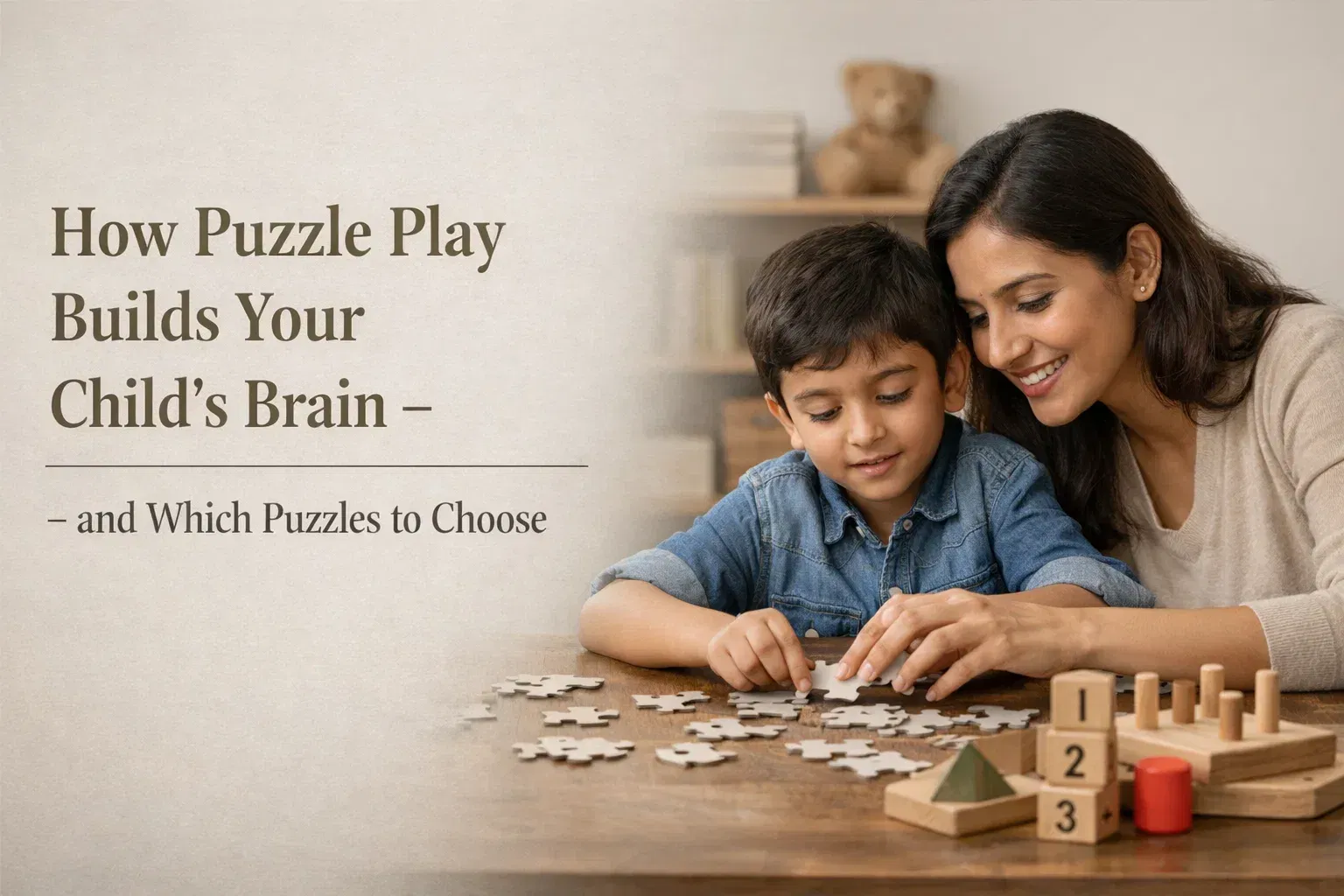
Ask a developmental psychologist what single toy category they would recommend for young children, and "puzzles" comes up again and again. Not because it's fashionable or because puzzle companies fund the research, but because the evidence - accumulated across decades and multiple scientific disciplines - consistently points in the same direction.
Puzzle play builds young brains in ways that are hard to replicate through other activities.
This guide unpacks exactly how and why that happens. We'll look at what the research says, which specific skills different types of puzzles develop, and how to match puzzle choices to your child's age and developmental stage.
If you've ever wondered whether that pile of jigsaw boxes is worth the drawer space, or whether the logic games on your child's tablet are doing any real good - this is your answer.
The Research: What Science Says About Puzzle Play
The case for puzzle play isn't anecdotal. It's built on solid, peer-reviewed research.
A nationally representative study published in Psychological Science (Jirout & Newcombe, 2015) found that children who played with puzzles, blocks, and board games more than six times per week scored significantly higher on spatial reasoning tests than peers who rarely engaged with these activities. Crucially, this relationship held across gender and socioeconomic background - making access to puzzles a potential equaliser for children who might otherwise have lower spatial reasoning scores.
Research from the University of Chicago (Levine et al., 2012) found that the amount and quality of puzzle play in children aged 2 to 4 predicted their spatial transformation skills at the start of kindergarten - the ability to mentally rotate and manipulate shapes. These spatial skills are, in turn, one of the strongest early predictors of mathematical ability and STEM performance in later schooling.
A Case Western Reserve University cognitive scientist summarised the broader transfer effect neatly: skills practised through puzzle-solving - pattern recognition, systematic elimination, spatial transformation - tend to transfer to other cognitively demanding tasks that draw on the same underlying abilities. Puzzle play doesn't just make children better at puzzles. It makes them better thinkers.
Also Read: 25 Best Puzzle Games for Kids Brain
 Dr. Prateek Phaldesai
8 Specific Ways Puzzle Games Help Children Develop
1. Spatial Reasoning and Geometry
This is the most well-documented benefit. When a child picks up a puzzle piece, mentally rotates it, and decides where it might fit, they are practising spatial transformation - a cognitive operation fundamental to geometry, engineering, architecture, and mathematics.
Children who do puzzles regularly develop a more intuitive understanding of how shapes relate to each other in space. This manifests in school as stronger performance in geometry, better reading of maps and diagrams, and - according to longitudinal research - higher scores in STEM subjects in secondary education.
Best puzzle types for spatial reasoning: Jigsaw puzzles, tangrams, sliding tile puzzles, maze games, 3D brainteasers
2. Fine Motor Skills and Hand-Eye Coordination
For younger children especially, the physical act of handling puzzle pieces is itself a workout. Picking up a small piece, rotating it between the fingers, aligning it precisely with an adjacent piece - all of this requires the coordinated effort of small muscles in the hands, fingers, and wrists.
Puzzle play is a great time to build cognitive and fine motor skills, but it can also be a time to build social, emotional, and language skills when caregivers use time with puzzles thoughtfully.
Fine motor skills developed through puzzle play transfer directly to other precision tasks: writing, drawing, cutting with scissors, buttoning clothes, using tools. For toddlers, this is some of the most important physical development happening through play.
Best puzzle types for fine motor development: Peg puzzles, small-piece jigsaws, pegboard patterns, tangram sets
3. Problem-Solving and Critical Thinking
Every puzzle is, at its core, a problem with a solution. To solve it, children must observe, hypothesise, test, and adjust - the same loop as the scientific method and formal problem-solving frameworks.
Children learn to work through a problem and reach a solution as they fit the pieces together. They may need to learn to set aside the piece they hope to put in the puzzle while searching for one that fits in the spot they need.
This capacity to hold a partial solution in mind, manage frustration at a dead end, and try a different approach is directly transferable to academic problem-solving and real-world challenges.
Best puzzle types for problem-solving: Logic grid puzzles, sliding tiles, maze games, coding puzzles, escape-room style challenges
4. Attention Span and Executive Function
In a world of notifications and short-form content, sustained attention is becoming an increasingly scarce skill. Puzzles are one of the few activities that naturally demand it.
Puzzles require concentrated effort and focus, which can be challenging for kids who are still learning to control their impulses and stay on task. By working on puzzles regularly, children develop the patience and persistence they need to complete a puzzle or any other activity requiring sustained effort.
Executive function - the set of mental processes that allow us to plan, focus, follow multi-step instructions, and manage competing demands - is one of the strongest predictors of academic success, stronger even than IQ by some measures. Puzzle play, done regularly, is executive function training in disguise.
5. Working Memory
Memory match games - where children must remember the position of unmatched cards to find pairs - are a direct workout for working memory. This is the mental workspace where we hold and manipulate information in real time: the same system we use to follow multi-step instructions, do mental arithmetic, and comprehend complex sentences.
Puzzle games, particularly those that involve memory recall and pattern recognition, can significantly improve our memory and learning capabilities. When solving puzzles, we are required to remember information, such as the placement of certain pieces or the sequence of a pattern. This constant exercise of memory retrieval strengthens our memory retention abilities.
Best puzzle types for working memory: Memory match games, jigsaw puzzles, sequence puzzles
6. Language Development and Vocabulary
Puzzles create natural moments for language-rich interaction between children and caregivers.
Use words such as turn, flip, and rotate when you are coaching children to fit puzzle pieces together. Children also learn words such as above, below, and beside when they describe the position of puzzle pieces in relation to each other.
These spatial vocabulary words are not just puzzle-specific - they are the building blocks of how children describe the physical world and later understand written descriptions of spatial relationships in text. Word puzzle games (crosswords, word searches, Wordle-style guessing games) add vocabulary and spelling development on top.
Best puzzle types for language development: Story sequencing puzzles, word puzzles, crosswords, puzzle play with a caregiver
7. Mathematical Thinking
Mathematics isn't just arithmetic. Much of early mathematical thinking involves categorisation, pattern recognition, prediction, and spatial reasoning - all of which puzzle play develops naturally.
Completing a puzzle is a fun way for your child to practice basic math skills such as categorising, spotting correlations, predicting outcomes, and decoding abstract patterns.
Tangrams introduce geometry through play. Sudoku develops number logic. Sliding tile puzzles develop sequencing. Coding games develop algorithmic thinking. Maths is woven through puzzle play in ways that feel nothing like school maths - which is precisely why children engage willingly.
Best puzzle types for mathematical thinking: Tangrams, Sudoku for kids, number grid games, coding puzzles, pattern-matching games
8. Emotional Resilience and Perseverance
This benefit is perhaps the least obvious but ultimately one of the most valuable.
Every puzzle has moments of frustration - a piece that won't fit, a path through a maze that dead-ends, a logical deduction that turns out to be wrong. How children navigate these moments matters enormously for their broader approach to challenges.
A child who is dedicated to completing their puzzle and goes on to finish it, even though it requires concentrating for longer than they usually can, is a child who is developing perseverance. This is a skill that is useful in every aspect of school and life after school. Kids also need to get past the frustration of not matching the correct pieces and making several mistakes, in order to build a bit of grit and determination.
The payoff at the end - a completed puzzle, a solved logic challenge, a cracked code - delivers a genuine sense of accomplishment. Over time, children internalise the lesson that difficult problems yield to sustained effort. That lesson changes how they approach challenges everywhere.
How to Match Puzzle Types to Your Child's Development Stage
Ages 2–4: Building Foundations
At this stage, children are developing grip strength, shape recognition, and the basic concept of cause and effect. Puzzles should have large pieces, simple images, and immediate rewards.
Ideal puzzle types: Peg puzzles (4-8 pieces), shape sorters, foam floor puzzles, chunky wooden jigsaws
Focus areas: Fine motor skills, shape recognition, hand-eye coordination, basic spatial awareness
Caregiver tip: Play alongside your child and narrate what you're doing. "Let's turn this piece around - now it fits!" The spatial vocabulary you use now becomes part of their thinking vocabulary later.
Dr. Prateek PhaldesaiAges 4–7: Building Confidence and Complexity
Children at this stage can manage more pieces, more abstract concepts, and more sustained focus. They're ready for memory games, simple logic, and puzzles that require multi-step thinking.
Ideal puzzle types: 24-100 piece jigsaws, memory match games, maze puzzles, story sequence cards, beginner tangrams, simple word games
Focus areas: Working memory, sequencing, problem-solving, early literacy and numeracy, perseverance
Caregiver tip: Introduce slightly challenging puzzles (just above comfortable level) and offer hints rather than solutions. "Where do you think the edge pieces go?" develops metacognitive strategies that children carry into all learning.
Ages 7–12: Building Thinking Systems
Older children are ready for rule-based challenges that require systematic thinking - puzzles where random trial and error won't work and where developing a strategy is the only path to success.
Ideal puzzle types: Logic grid puzzles, Sudoku, sliding tile games (8-puzzle), crosswords, Wordle-style word games, chess, coding puzzles, 100–500 piece jigsaws
Focus areas: Deductive reasoning, vocabulary, mathematical logic, strategic planning, executive function
Caregiver tip: Encourage children to explain their reasoning aloud ("Why did you put that piece there?"). Verbalising thinking strengthens the cognitive process and develops metacognitive awareness - the ability to think about thinking.
The Screen Question: Digital Puzzle Games vs Physical Ones
This question comes up constantly. The short answer is: both have genuine value, and both have limitations.
Physical puzzles offer:
- Tactile engagement that builds fine motor skills more effectively
- Naturally bounded sessions (the puzzle ends when it's done)
- Better social interaction when done with others
- No risk of algorithmic rabbit holes
Digital puzzle games offer:
- Immediate feedback that accelerates learning loops
- Vast variety at low or zero cost
- Adjustable difficulty that adapts to the child's level
- Accessibility - they travel anywhere a device travels
The best approach is a deliberate mix. Use physical puzzles for younger children and for family puzzle time. Use digital games as a complement - particularly the curated educational platforms - rather than a replacement.
Making Puzzle Play a Habit
The research is clear that frequency matters. Children who engage with puzzles regularly (more than six times a week) show significantly stronger development than those who puzzle occasionally. This doesn't mean marathon sessions - even 10-15 minutes of puzzle play daily adds up to meaningful cognitive exercise over weeks and months.
Some practical ways to build puzzle play into daily life:
- Morning routine puzzle: Keep a jigsaw in progress on a table your child passes every morning
- Car-trip logic games: Verbal puzzle games (I Spy, Twenty Questions, riddles) work anywhere
- After-school decompression: A quiet puzzle session after school gives children a mentally active but calming transition out of the school day
- Family puzzle nights: Replacing some screen time with a shared puzzle challenge builds connection alongside cognition
- Rotate the collection: Fresh puzzles maintain motivation; familiar ones build independence and confidence
FAQs
At what age should children start doing puzzles?
Children can engage with simple shape-sorting toys from around 18 months. Peg puzzles with 4-6 pieces suit children aged 2-3. By ages 3–4, most children are ready for simple jigsaws. There's no upper age limit - puzzles remain cognitively valuable throughout childhood and beyond.
Do puzzle games actually improve school performance?
Indirectly, yes. The cognitive skills built through puzzle play - spatial reasoning, working memory, sustained attention, logical thinking - all contribute positively to academic performance. Spatial reasoning in particular has been shown to predict mathematical ability. Puzzle play isn't a substitute for studying, but it builds the mental infrastructure that makes learning easier.
How difficult should a puzzle be for my child?
The 80/20 principle is a useful guide: children should be able to complete about 80% of the puzzle comfortably, with the remaining 20% requiring real effort. Too easy leads to boredom. Too hard leads to frustration. The sweet spot - achievable with effort - is where growth happens.
Are puzzle games good for anxious children?
Often, yes. Puzzles are such an enjoyable and calming activity that even many adults enjoy doing them. They release stress, encourage mindfulness and are a good way to calm an anxious child. The focused, low-stakes nature of puzzle play makes it a natural self-regulation tool for children who find other activities overwhelming.